
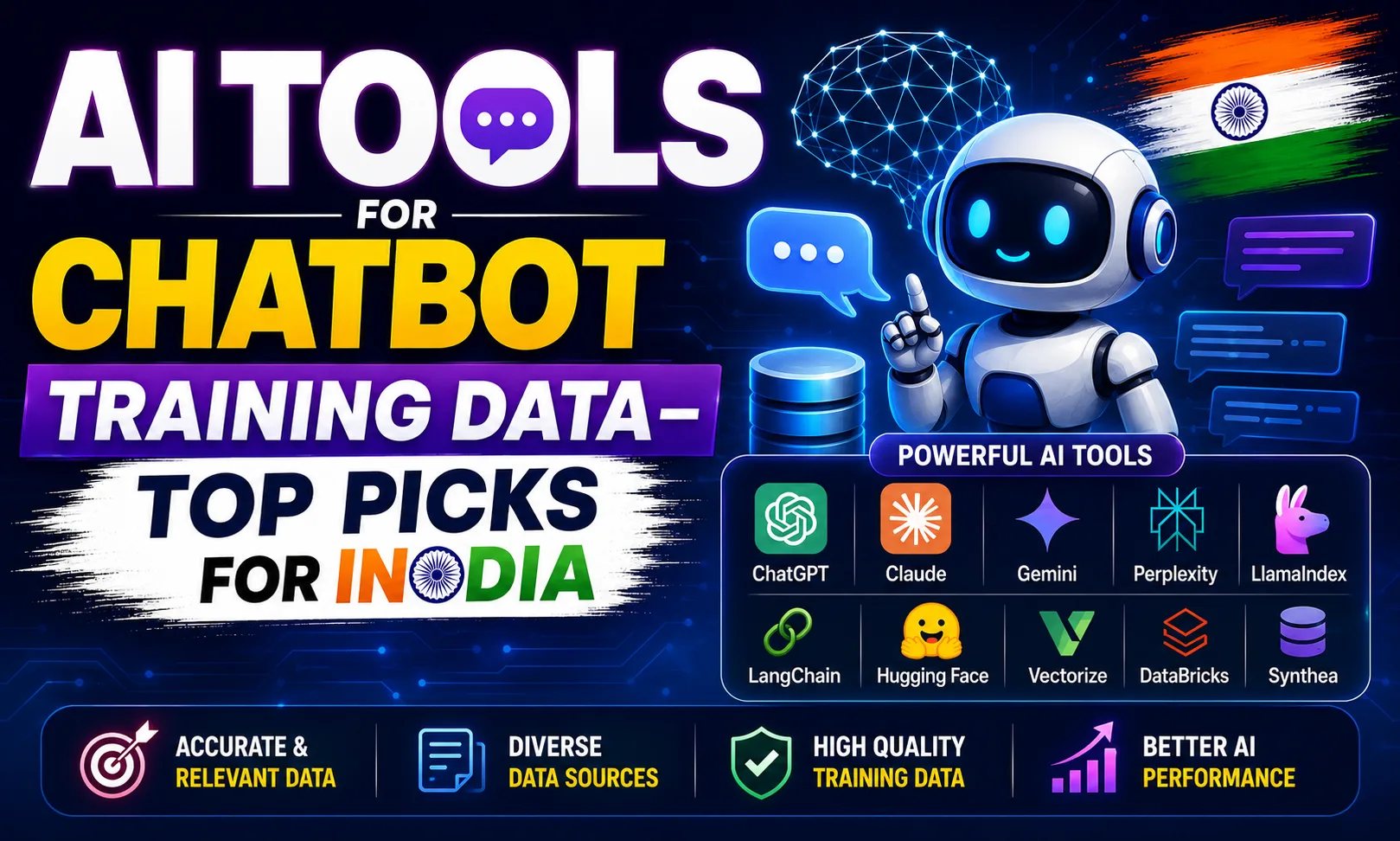
AI tools for chatbot training data are changing how Indian small businesses build smarter bots — faster, cheaper, and without a tech team. Whether you run a D2C brand on Instagram, a kirana chain, or a service business taking WhatsApp bookings, the quality of your chatbot’s training data decides everything.
Table of Contents
- Quick Comparison: AI Tools for Chatbot Training Data
- 1. Claude — Best AI Tool for Chatbot Training Data with Long-Context Q&A
- 2. Gemini — Best AI Tools for Chatbot Training Data in Indian Languages
- 3. Google AI Pro — Best AI Tools for Chatbot Training Data at Enterprise Scale
- 4. Perplexity — Best AI Tool for Research-Backed Chatbot Training Data
- 5. Nova AI — Best Budget AI Tool for Chatbot Training Data for SMBs
- How to Pick the Right AI Tool for Chatbot Training Data
- My Personal Pick from These AI Tools for Chatbot Training Data
- FAQs About AI Tools for Chatbot Training Data
Quick Comparison: AI Tools for Chatbot Training Data
| Tool | Free Plan | Paid Plan | Best For | Hindi/Regional |
|---|---|---|---|---|
| Claude | Yes | [aitool id=”claude”] | Long-form Q&A datasets | Good |
| Gemini | Yes | [aitool id=”gemini”] | Multilingual intents | Excellent |
| Google AI Pro | Limited | [aitool id=”google-ai-pro”] | Enterprise dataset generation | Excellent |
| Perplexity | Yes | [aitool id=”perplexity”] | Research-backed FAQs | Moderate |
| Nova AI | Yes | [aitool id=”nova-ai”] | Budget-friendly SMB use | Moderate |
Buy AI Tools at Cheapest Price
1. Claude — Best AI Tool for Chatbot Training Data with Long-Context Q&A
AI tools for chatbot training data don’t get better than Claude when your bot needs to handle nuanced, multi-turn conversations. Claude by Anthropic has one of the largest context windows available right now — meaning you can paste your entire product catalogue, FAQ document, or Razorpay payment policy and ask it to generate structured intent-utterance pairs in one shot. For a WhatsApp Business bot handling Diwali sale queries, that’s massive.
I’ve personally used Claude to generate training data for a client’s customer support bot. I gave it 40 real WhatsApp chat screenshots (anonymised), and it produced 120 intent variations with entity tags in under ten minutes. The output format was clean enough to directly upload to Dialogflow. No Upwork freelancer needed. The free plan has daily limits but is genuinely usable for small batches — try it before paying.
One honest limitation: Claude’s Hindi output is decent but not perfect. If your chatbot training data needs pure Hinglish or heavy regional dialect handling — say, for a Tier-2 city auto-parts supplier — you’ll want to pair Claude with a native speaker for review. Still, for English-first D2C brands, it’s my top pick among AI tools for chatbot training data.
2. Gemini — Best AI Tools for Chatbot Training Data in Indian Languages
AI tools for chatbot training data that actually understand Hindi, Tamil, Bengali, and Marathi are rare. Gemini is not rare in this regard — it’s genuinely strong. Google’s Gemini was trained with a serious focus on multilingual data, and it shows when you ask it to generate chatbot training utterances in mixed Hindi-English. For a grocery delivery startup in Lucknow or Jaipur, this is the tool to test first.
What makes Gemini particularly useful is its integration with Google Workspace. If your team already documents SOPs in Google Docs, you can use Gemini to pull that content and auto-generate FAQ pairs for your chatbot. Festival season preparation — think Navratri sale queries or Eid delivery window FAQs — becomes a one-hour job instead of a three-day freelancer project. The free tier inside Google products is generous enough for initial training data generation.
Paid plans unlock higher volume and better API access, which matters when you’re building production-grade chatbot training datasets for thousands of intents. See [aitool id=”gemini”] for current pricing. One thing I noticed: Gemini sometimes over-formats outputs with markdown tables when you want plain JSON. Just specify your output format clearly in the prompt — it follows instructions well.
3. Google AI Pro — Best AI Tools for Chatbot Training Data at Enterprise Scale
If you’re past the “startup experimenting” phase and actually running a call centre or a large WhatsApp Business API deployment, Google AI Pro is where things get serious. It gives you access to advanced Gemini models with higher rate limits, longer context, and better consistency — which directly translates to higher-quality chatbot training data at volume.
Indian enterprises using platforms like WATI or Interakt for WhatsApp automation will benefit from Google AI Pro’s ability to generate thousands of labelled utterances with consistent entity recognition. Pricing sits at [aitool id=”google-ai-pro”] — worth it if you’re generating training data regularly rather than just once. The free tier is limited, so treat it as a trial window only.
4. Perplexity — Best AI Tool for Research-Backed Chatbot Training Data
Here’s a use case people miss: your chatbot training data needs to reflect what users actually ask online, not just what you think they ask. Perplexity is a search-first AI that cites real sources, which makes it excellent for generating FAQ content grounded in actual user search behaviour. Ask it “what do Indian customers ask about UPI refunds?” and it gives you cited, real-world questions you can directly convert into training utterances.
For a fintech chatbot or an e-commerce returns bot, this source-backed approach dramatically reduces the “garbage in, garbage out” problem that kills most first-time chatbot projects. Pricing details at [aitool id=”perplexity”]. The free plan covers a solid number of daily queries — enough to bootstrap a dataset for a focused domain like payment FAQs or shipping queries. Not ideal for multilingual training data generation, though.
5. Nova AI — Best Budget AI Tool for Chatbot Training Data for SMBs
Nova AI is the underdog here, but it earns its spot. For small Indian businesses — a boutique salon chain in Pune, a tiffin service in Mumbai — that need basic chatbot training data without a steep learning curve, Nova AI is accessible and affordable. It handles conversational data generation well for English and basic Hindi prompts.
Check [aitool id=”nova-ai”] for pricing — it’s one of the more budget-friendly AI tools for chatbot training data on this list. Don’t expect enterprise-grade output, but for 50–100 intents on a WhatsApp bot for local delivery or appointment booking, it does the job cleanly.
How to Pick the Right AI Tool for Chatbot Training Data
- Step 1: Define your chatbot’s domain first
Before picking any AI tool for chatbot training data, list the top 20 things your bot must handle. Payment queries? Product FAQs? Booking confirmations? This shapes your tool choice completely. - Step 2: Check language requirements
If your users speak Hindi, Tamil, or Marathi, prioritise Gemini or Google AI Pro. For English-first brands, Claude is faster and cleaner. Don’t assume any tool handles regional languages equally well — test with 10 sample utterances first. - Step 3: Decide on volume
Under 200 intents? Free plans on Claude or Gemini are enough. Over 1,000 intents for a production bot? You need paid tiers or API access. Factor this into your budget — typically ₹1,500–₹2,500/month (roughly $18–$30) for a good paid plan. - Step 4: Test output format compatibility
Your chatbot platform — be it Dialogflow, WATI, or a custom Node.js setup — needs data in a specific format. Always ask the AI tool to output in JSON or CSV and verify it matches before committing to a tool. Check our guide to chatbot builders for India for format compatibility details. - Step 5: Run a festival-season dry run
Indian chatbots face peak load during Diwali, Eid, and IPL season. Generate a test dataset for a high-traffic scenario and see how fast and accurate the AI tool performs under that content volume.
My Personal Pick from These AI Tools for Chatbot Training Data
Honestly, for most Indian small businesses, I’d start with Gemini’s free tier. It handles Hindi reasonably well, integrates with Google Docs (where most Indian teams already work), and produces clean conversational data fast. Once you hit scale or need deeper customisation, upgrade to Claude’s paid plan — its instruction-following for structured output is unmatched among AI tools for chatbot training data right now.
If you’re on a tight budget and just need to get a WhatsApp bot live before the next festive season, Nova AI gets the job done without complexity. And if your use case is research-heavy — like a banking or insurance chatbot — Perplexity’s source-cited FAQ generation saves serious time. You can also explore our WhatsApp chatbot tools comparison to pair these training data generators with the right deployment platform.
One thing I keep telling founders: the AI tool is only 30% of the job. The other 70% is curation — reading the generated data, removing hallucinations, and adding your brand’s specific edge cases. These AI tools for chatbot training data are your starting point, not your finish line. Try the free plan of whichever fits your language and volume needs, generate a sample dataset, and judge by the actual output quality before spending anything.
For a broader view of what’s available, the AI tools for customer support in India guide covers how training data quality maps to real chatbot performance metrics.
FAQs About AI Tools for Chatbot Training Data
Q: Which AI tools for chatbot training data work best with Hindi and regional Indian languages?
A: Gemini and Google AI Pro are the strongest AI tools for chatbot training data in Hindi, Tamil, Bengali, and Marathi. Gemini was built with multilingual support as a priority, and real-world testing shows noticeably better output quality for Hinglish and regional language intents compared to other options. Claude is a good second for Hindi but works best for English-first training datasets.
Q: Can I use free AI tools for chatbot training data if I’m a small business?
A: Yes. Claude, Gemini, Perplexity, and Nova AI all have free tiers that are genuinely usable for generating 50–150 intents. For a basic WhatsApp Business bot covering order tracking, payment FAQs, and store hours, the free plan on any of these tools is enough to get started. Just expect daily usage limits that slow down large-batch generation.
Q: What format should AI tools for chatbot training data output for platforms like Dialogflow?
A: Dialogflow prefers JSON with intent name, training phrases array, and entity tags. When using any AI tool for chatbot training data, explicitly ask it to format output as JSON with these fields. Claude and Gemini both follow this instruction reliably. Always validate the output against Dialogflow’s import schema before uploading to avoid errors.
Q: How many training utterances per intent should I generate using AI tools for chatbot training data?
A: A minimum of 10–15 utterances per intent is the standard recommendation for basic NLU models. For production-grade chatbots handling high-traffic Indian WhatsApp deployments, aim for 25–40 utterances per intent, including variations with typos, abbreviations, and Hinglish phrasing. AI tools for chatbot training data can generate this volume in minutes — the key is reviewing for quality, not just quantity.
Q: Are AI tools for chatbot training data suitable for festival season chatbot preparation?
A: Absolutely — this is actually one of the best use cases. Before Diwali, Eid, or year-end sales, you can use tools like Claude or Gemini to generate hundreds of intent variations around discount queries, delivery window FAQs, return policies, and UPI payment issues — all specific to the festival context. Doing this 2–3 weeks before a sale peak gives your team time to review and deploy a well-trained bot before traffic spikes.