
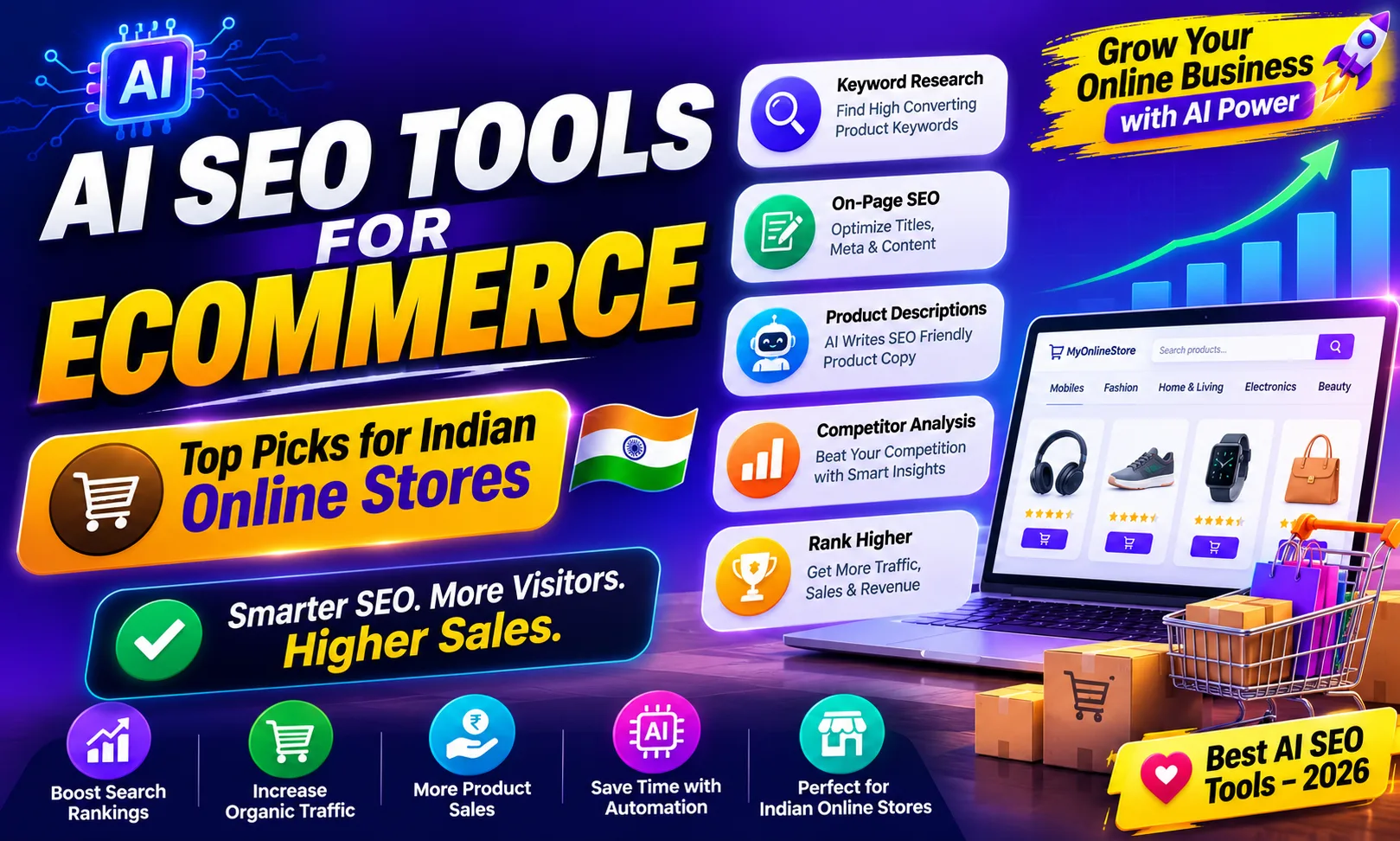
AI SEO tools for ecommerce are no longer a luxury — if you’re running a Shopify, WooCommerce, or Meesho seller store and trying to rank on Google India, you need them. I’ve tested a bunch of these tools for product pages, category descriptions, and keyword research, and honestly, the difference is night and day compared to doing it all manually.
Table of Contents
- Quick Comparison: AI SEO Tools for Ecommerce
- 1. Semrush — Best AI SEO Tools for Ecommerce Full-Suite Option
- 2. Surfer SEO — Best AI SEO Tools for Ecommerce On-Page Scoring
- 3. Ahrefs — Best AI SEO Tools for Ecommerce Keyword + Backlink Research
- 4. Scalenut — Best AI SEO Tools for Ecommerce Content Briefs
- 5. Writesonic — Best AI SEO Tools for Ecommerce Bulk Product Descriptions
- 6. Ubersuggest — Best AI SEO Tools for Ecommerce on a Tight Budget
- How to Pick the Right AI SEO Tool for Your Ecommerce Store
- My Personal Pick from These AI SEO Tools for Ecommerce
Quick Comparison: AI SEO Tools for Ecommerce
| Tool | Best For | Free Plan |
|---|---|---|
Buy AI Tools at Cheapest Price
1. Semrush — Best AI SEO Tools for Ecommerce Full-Suite Option
Semrush is the closest thing to an all-in-one AI SEO tool for ecommerce that actually delivers. The Keyword Magic Tool gives you search volume data specific to India — so you can see exactly how many people search “cotton kurti under 500” vs “cotton kurti online buy.” That’s genuinely useful if you’re building category pages for Diwali or wedding season collections.
The AI-powered On-Page SEO Checker tells you precisely which elements to fix on each product or category page — title tags, meta descriptions, missing internal links, thin content. For ecommerce sites with 500+ SKUs, this alone saves hours. I’ve used it to audit WooCommerce stores and the competitor gap analysis feature is sharp — it shows which keywords your top 5 competitors rank for that you don’t.
Honestly, the price is steep for solo sellers. But if you’re running a D2C brand doing ₹10–50 lakh/month, the ROI math works. Semrush’s website has a 7-day free trial — enough to do a full keyword gap audit.
2. Surfer SEO — Best AI SEO Tools for Ecommerce On-Page Scoring
Surfer SEO focuses on one thing: helping you write and optimize content that Google actually ranks. For ecommerce, this means your category pages and long-form buying guides get a real-time content score as you write. The NLP-based suggestions are solid — it tells you which related terms to include, how long your page should be, and how many headings to use based on what’s already ranking.
The Content Editor integrates with Google Docs, which is great if you have a team of freelancers on Upwork writing product descriptions for you. You can share a brief with a content score target and anyone can follow it without needing to log in to Surfer themselves. Surfer SEO’s content editor is genuinely one of the best for ecommerce blog posts and buyer guides.
No free plan is the main drawback. But the Grow plan is reasonable if you’re publishing 3–5 optimized pages per month. Try it for one month before committing.
3. Ahrefs — Best AI SEO Tools for Ecommerce Keyword + Backlink Research
Ahrefs is what I go back to every time I need to understand why a competitor’s product page is outranking mine. The Site Explorer shows backlink profiles in detail. For ecommerce, understanding which sites are linking to Myntra or Nykaa for a specific product category is powerful — you can target the same publishers with your own outreach.
The Keywords Explorer has solid India-specific data. You can filter by country and see CPC values (useful for understanding commercial intent). The “Also rank for” and “Questions” features surface long-tail queries like “best face serum for oily skin India” that are perfect for blog content supporting your product pages.
Ahrefs doesn’t have a full AI content writer built in, but it’s unmatched for research. Pair it with Scalenut or Writesonic for the writing side. Check Ahrefs pricing.
4. Scalenut — Best AI SEO Tools for Ecommerce Content Briefs
Scalenut is a Bangalore-based tool — and it shows in how well it handles Indian English and Indian search intent. The Cruise Mode feature lets you go from keyword to a full SEO-optimized article in minutes. For ecommerce, I use it mainly for buying guides and “best X under ₹Y” style content that drives top-of-funnel traffic.
The SEO Research tab pulls competitor data and gives you a topic cluster view. This is excellent for building content silos around a product category — like “running shoes” linking out to “how to choose running shoes,” “best running shoes for flat feet,” etc. Each page supports the others and the whole cluster ranks better together.
The free trial is limited but worth it to test the quality.
5. Writesonic — Best AI SEO Tools for Ecommerce Bulk Product Descriptions
If you have 200 products that all need unique descriptions, Writesonic is the tool. The Bulk Generation feature lets you upload a CSV with product names and attributes and get SEO-friendly descriptions back fast. For Flipkart or Amazon sellers managing large catalogs, this cuts days of work down to an afternoon.
Writesonic also has a decent free plan — you get limited credits to test the quality before paying anything. The output needs human editing, but it’s a solid first draft. Check Writesonic’s current plan pricing.
6. Ubersuggest — Best AI SEO Tools for Ecommerce on a Tight Budget
Ubersuggest is Neil Patel’s tool and it’s genuinely the most accessible AI SEO tool for ecommerce beginners. The free version gives you 3 searches per day — enough to validate a few keywords before investing in a paid plan. For small sellers just starting on Shopify, this is where I’d tell you to begin.
The AI Writer and keyword suggestions are basic compared to Semrush or Ahrefs. But the lifetime deal it occasionally runs (around $290 one-time) is insane value for solo store owners.
How to Pick the Right AI SEO Tool for Your Ecommerce Store
- Step 1: Define your primary need
Are you doing keyword research, writing content, or fixing on-page issues? Different AI SEO tools for ecommerce excel at different things. Ahrefs and Semrush for research, Surfer for on-page, Writesonic for content creation. - Step 2: Match budget to store size
A store doing under ₹5 lakh/month should start with Ubersuggest or Scalenut’s entry plan. Bigger D2C brands need Semrush or Ahrefs. Check AI SEO tool pricing comparisons for India before deciding. - Step 3: Test with a real keyword
Pick one high-intent category keyword — like “handmade leather bags online India” — and run it through 2–3 tools. Compare the data quality and suggestions. The tool that gives you the most actionable output wins. - Step 4: Check for India-specific data
Not every AI SEO tool for ecommerce shows accurate Indian search volumes. Confirm the tool has India as a filterable region with real CPC and volume data — not just US-based estimates. - Step 5: Start with one, expand later
Don’t buy 4 tools at once. Start with the one that solves your biggest bottleneck. Once that’s working, layer in a second. Most stores see results from just one well-used AI SEO tool for ecommerce.
See how AI keyword research tools work for Indian ecommerce to go deeper on the research step.
My Personal Pick from These AI SEO Tools for Ecommerce
Honestly, if I had to pick one AI SEO tool for ecommerce and stick with it, it would be Semrush — but only if your store is generating enough revenue to justify the cost. The data depth, the AI-assisted on-page checker, and the competitor gap analysis together make it worth it for serious stores.
For solo sellers or early-stage D2C brands? Start with Ubersuggest’s free plan + Writesonic’s free tier. Use them together: Ubersuggest for finding keywords, Writesonic for writing product descriptions. That combo costs you nothing until you’re ready to scale. See how AI content tools support ecommerce growth to plan your next move.
The best AI SEO tools for ecommerce are the ones you actually use consistently — not the most expensive ones sitting in a tab you never open.
Q: Which AI SEO tools for ecommerce work best for Indian Google rankings?
A: Semrush and Ahrefs have the most accurate India-specific keyword data with real search volumes and CPC. Scalenut, being India-based, also handles Indian English content well. For on-page optimization targeting Google India, Surfer SEO is strong. The best AI SEO tools for ecommerce in India depend on whether you need research, content, or technical SEO help.
Q: Are there free AI SEO tools for ecommerce I can use right now?
A: Yes. Ubersuggest offers 3 free searches per day — enough for early-stage stores. Writesonic has a free plan with limited credits for product description generation. Semrush’s free account gives access to limited keyword data. These free AI SEO tools for ecommerce are solid starting points before committing to paid plans.
Q: How do AI SEO tools for ecommerce help with product page rankings?
A: AI SEO tools for ecommerce analyze competitor product pages, suggest target keywords, generate optimized meta titles and descriptions, flag thin content, and score your pages against top-ranking competitors. Surfer SEO’s content editor, for example, gives a real-time SEO score as you write a product or category page description.
Q: Can AI SEO tools for ecommerce help during Indian festival seasons like Diwali?
A: Absolutely. Tools like Semrush and Ahrefs show seasonal search trend spikes for terms like “Diwali gift hampers” or “ethnic wear sale.” You can plan content 2–3 months before the festival, create optimized category pages, and capture organic traffic that competitors miss. Scalenut can then generate the actual content briefs and articles for those pages.
Q: What’s a realistic budget for AI SEO tools for ecommerce in India?
A: At ₹85/USD, Ubersuggest’s paid plan costs around ₹2,500/month, Scalenut around ₹3,300/month, and Semrush Pro around ₹12,000/month. For stores doing ₹5–10 lakh/month revenue, a mid-tier AI SEO tool for ecommerce at ₹3,000–5,000/month makes sense. Larger D2C brands can justify Semrush or Ahrefs at higher price points once organic traffic ROI is clear.
Try the free plan on any of these tools this week — even one optimized product page can make a real difference to your Google rankings.