
Last month, a freelance client of mine — a D2C skincare brand from Pune — handed me a ₹40,000/month marketing budget and asked me to make it work. Half the team wanted to stick with what they knew: Mailchimp, Canva Pro, a social scheduling tool, and a copywriter on retainer. The other half had been watching every “AI will replace marketers” Reel and wanted to go all-in on AI. I had to make the call.
This post is that call — a proper AI vs traditional marketing tools comparison based on actual use, not theory. I’ll cover cost, output quality, speed, and where each side genuinely wins.
Quick Verdict — Before You Read the Whole Thing
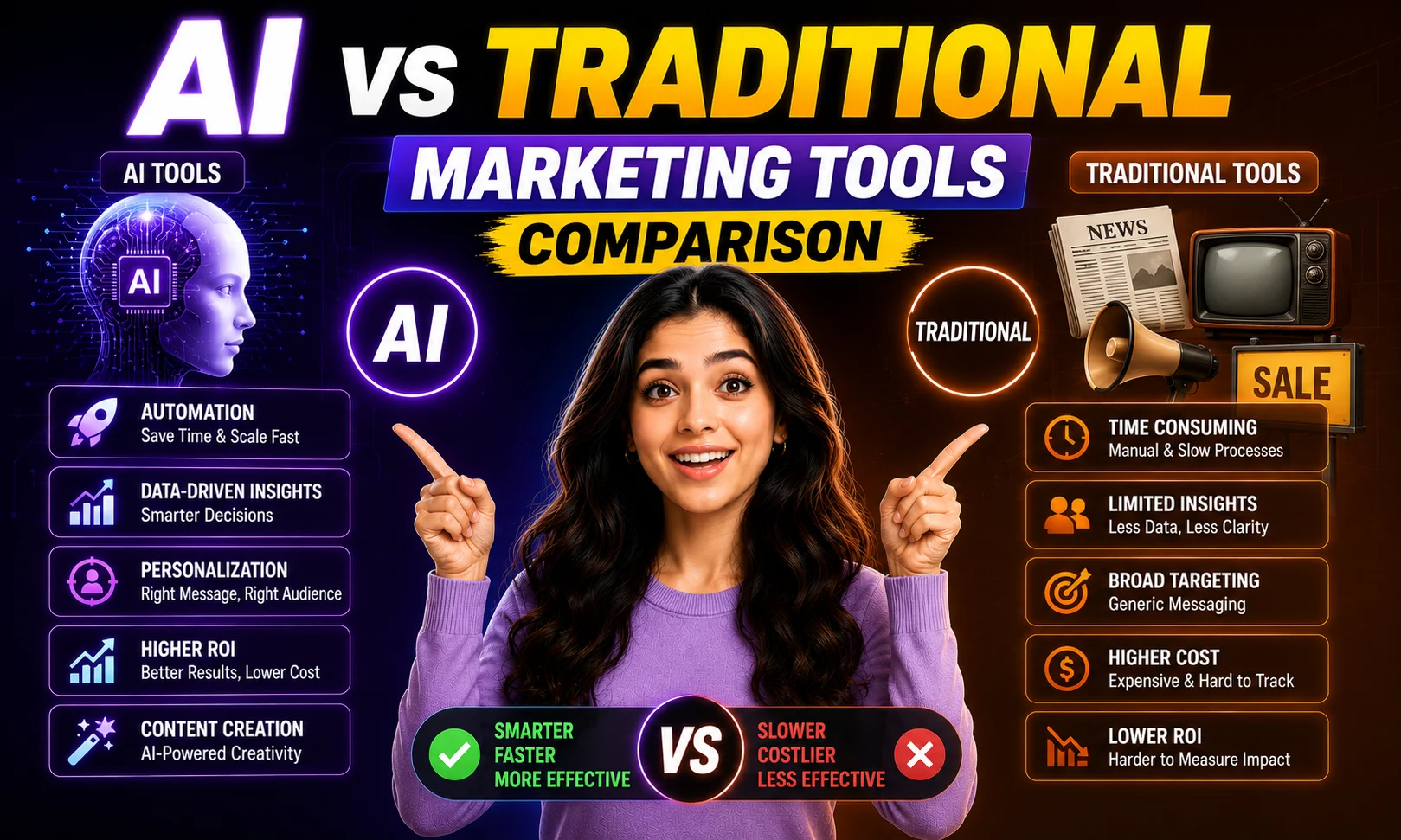
Honestly, neither side wins cleanly. AI tools are faster and cheaper for content, copy, and automation. Traditional tools are still better for brand consistency, complex design, and anything that needs a human editorial eye. Most Indian marketing teams — agencies or in-house — will end up running both. The real question is which category gets more of your budget.
If you want a deeper look at the AI side specifically, OpenAI’s official site is worth bookmarking for understanding what these models can actually do. And for research context, India AI’s government portal has solid data on AI adoption trends in the Indian market.
AI vs Traditional Marketing Tools Comparison At a Glance
| Factor | AI Tools | Traditional Tools |
|---|---|---|
| Speed | Very fast — minutes per asset | Slower — depends on team/process |
| Cost (entry level) | ₹850–₹2,500/month | ₹1,200–₹8,000/month per tool |
| Brand consistency | Needs heavy prompting/setup | Built into templates and workflows |
| Learning curve | Low to moderate | Low — most teams already know them |
| Scalability | Very high | Limited by headcount |
| Output quality ceiling | Good, not always great | High with skilled team |
| Indian language support | Improving, still patchy | Depends on the human |
Buy AI Tools at Cheapest Price
Real Use Cases for This AI vs Traditional Marketing Tools Comparison
Let me get specific, because broad comparisons don’t help anyone actually running campaigns.
Email marketing: I ran the same campaign brief through Mailchimp’s built-in content studio (traditional) and through ChatGPT + Mailchimp (AI-assisted). The AI-assisted version produced 6 subject line variations in under 3 minutes. The Mailchimp native tool gave me 2. Open rates on the AI-written subject lines were 4% higher over a 3,000-subscriber list. That’s meaningful for a ₹15,000 campaign spend.
Social content: A wedding photography client needed 30 Instagram captions for a Diwali series. A freelance copywriter on Upwork quoted ₹6,000 and 4 days. I used Claude with a detailed brand-voice prompt — at no extra cost, done in 40 minutes. Were all 30 perfect? No. I edited maybe 8 of them. But the time math is brutal for traditional here.
Ad copy: Google Ads copy is where I’ve seen the most consistent AI wins. Tools like Jasper or even a well-prompted ChatGPT generate 10 headline variants fast. A/B testing becomes much easier when iteration costs almost nothing. Traditional approach — either a copywriter retainer or doing it yourself — can’t match that volume.
For context on how Indian brands are approaching this, check out our breakdown of the best AI writing tools — I’ve tested most of them on actual client briefs.
Where AI Tools Win
The AI side of this comparison wins clearly in a few specific situations.
- Volume content: Product descriptions, blog drafts, email sequences — if you need 50 of something, AI pays for itself in the first hour.
- Solo operators and small agencies: If you’re a 2-person agency in Jaipur or a founder doing your own marketing, AI tools let you punch above your weight class without hiring.
- Campaign ideation: Brainstorming ad angles, naming products, generating hooks — AI is genuinely useful here and often surprises you.
- 24/7 availability: No waiting for a freelancer to come online. I’ve pushed out campaign assets at 11 PM before a client deadline. Traditional tools don’t complain, but they also don’t think.
The AI vs traditional marketing tools comparison tilts heavily toward AI when your bottleneck is output speed and your budget is under ₹5,000/month for tools.
Where Traditional Tools Still Hold Their Ground
See, here’s the thing — traditional tools aren’t dying. They’re just being repositioned.
Canva Pro still beats AI image generators for brand-consistent social graphics. Yes, Midjourney and Adobe Firefly are impressive. But getting them to produce an image that matches your exact brand palette, font choice, and layout grid? That takes significant effort. Canva does it in 4 clicks with a saved template.
CRM and email automation platforms — Mailchimp, HubSpot, Zoho — have years of integrations, compliance features, and deliverability infrastructure that AI-native tools simply don’t have yet. You’re not replacing these with a chatbot.
Analytics tools like Google Analytics or Hotjar are in a category AI hasn’t meaningfully entered yet for most Indian businesses. Reading heatmaps, funnel analysis, attribution — this still requires human judgment + reliable data infrastructure.
Traditional marketing tools also win on team onboarding. A new hire already knows Canva and Mailchimp. Getting your team aligned on the right AI prompting approach takes weeks of calibration. That hidden cost doesn’t show up in any SaaS comparison but it’s very real.
Pricing — What You Actually Pay in India
Let’s put real numbers on this AI vs traditional marketing tools comparison.
Traditional stack (small agency): Canva Pro (~₹4,000/year = ₹333/month), Mailchimp Essentials ($13/month = ₹1,100), Hootsuite or Buffer (~$18/month = ₹1,530), a copywriter retainer on Fiverr or Upwork (₹8,000–₹25,000/month depending on quality). Total: easily ₹12,000–₹28,000/month.
AI-first stack: ChatGPT Plus ($20/month = ₹1,700), Claude Pro ($20/month = ₹1,700), Canva Pro (still keep this — ₹333/month), Midjourney Basic ($10/month = ₹850). Total: roughly ₹4,600/month and you can drop the copywriter retainer for most content needs.
That’s a ₹7,000–₹23,000/month difference. For a bootstrapped founder or a lean agency, that gap is significant. Paisa vasool — genuinely, in this case.
Worth noting: many AI tools have free tiers that are actually useful. ChatGPT free, Claude free, and Gemini free can handle a surprising amount of work before you hit limits.
Which Should You Pick?
Honestly, the right answer for 90% of Indian marketers is a hybrid. Use AI for high-volume, repeatable content work. Keep traditional tools for brand assets, CRM, and analytics. Don’t throw out what’s working just because something shiny showed up.
If you’re a solo consultant or early-stage startup, go AI-heavy. Your speed advantage is too valuable to leave on the table. If you’re a mid-size agency with clients who care about premium design and brand voice, keep your traditional tools and add AI as a support layer — not a replacement.
And if you’re still figuring out where to start, our guide to free AI tools worth trying is a no-risk starting point before you spend a rupee.
FAQs About AI vs Traditional Marketing Tools Comparison
Is AI really better than traditional marketing tools for small businesses?
For content volume and speed, yes. For brand design and email deliverability infrastructure, not yet. Small businesses benefit most from AI tools when they can’t afford a large team.
Can AI tools work for Indian regional language marketing?
Partially. Hindi is decent, Tamil and Telugu are improving. But for high-stakes regional campaigns, a human reviewer is still necessary. This is one area where traditional (human) wins clearly.
Does this comparison change for agencies vs in-house teams?
Yes. Agencies with multiple clients benefit from AI’s scalability more than in-house teams. In-house teams with one brand might prioritize consistency over speed — which skews toward traditional tools.
What’s the biggest mistake in this comparison?
Treating it as either/or. The AI vs traditional marketing tools comparison isn’t a binary choice. Most teams doing good work right now are running both, intelligently.
Try one AI tool on a real campaign this month. Compare the output, the time, and the cost. Drop what you find in the comments — I’m genuinely curious what’s working for people.