
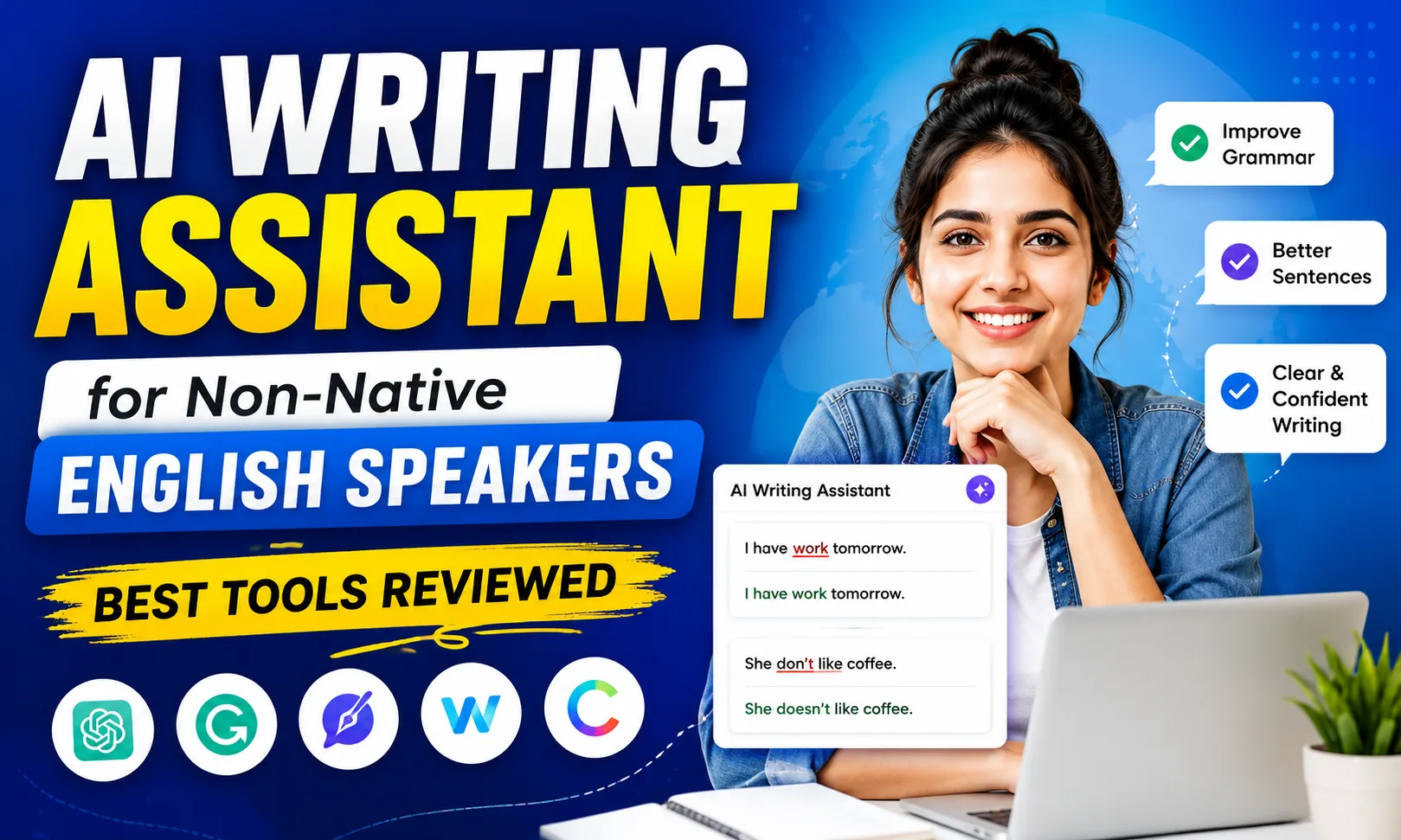
An AI writing assistant for non-native English speakers can genuinely change how you write — fixing grammar, improving tone, and making your English sound natural without years of practice. I’ve tested several of these tools as someone who grew up writing in Hinglish before switching to professional English. Here’s what actually works.
Table of Contents
- What Is an AI Writing Assistant for Non-Native English Speakers?
- Who Is an AI Writing Assistant for Non-Native English Speakers For?
- How to Use an AI Writing Assistant for Non-Native English Speakers
- What I Liked About AI Writing Assistants for Non-Native English Speakers
- What AI Writing Assistants for Non-Native English Speakers Don’t Do Well
- AI Writing Assistant for Non-Native English Speakers Pricing — Worth It in India?
- How AI Writing Assistants for Non-Native English Speakers Compare
- FAQs About AI Writing Assistants for Non-Native English Speakers
What Is an AI Writing Assistant for Non-Native English Speakers?
An AI writing assistant for non-native English speakers is a software tool that uses machine learning to detect grammar errors, suggest better phrasing, fix tone mismatches, and help you write fluent English — even if it isn’t your first language.
This is different from a basic spell-checker. Tools like Grammarly or QuillBot understand context. They know that “I am having hunger” sounds off to a native speaker, even though it’s technically logical. That kind of cultural-linguistic gap is exactly what these tools are trained to bridge.
According to IndiaAI, India has one of the fastest-growing bases of English-language internet users — most of whom learned English as a second or third language. So this isn’t a niche problem. It’s a massive one.
Who Is an AI Writing Assistant for Non-Native English Speakers For?
Honestly, this is for almost anyone writing professional English in India. But let me be specific:
— Freelancers on Upwork or Fiverr who write blog posts, product descriptions, or ad copy for international clients. A grammatical slip can tank your rating fast.
— Students writing research papers, SOP drafts, or scholarship essays where formal English is judged strictly.
— Startup founders writing pitch decks, investor emails, or LinkedIn posts. You know your idea is good — the English shouldn’t be the barrier.
— Content marketers at small agencies churning 10–15 articles a week. Speed matters, and an AI writing assistant for non-native English speakers saves at least 30 minutes per article in editing time.
— Job seekers writing resumes and cover letters. Using an AI writing assistant here can literally change your shortlist rate.
If you write in English for work and it’s not your mother tongue, this category of tools was built for you.
How to Use an AI Writing Assistant for Non-Native English Speakers
- Step 1: Pick your primary use case
Are you fixing existing drafts, or generating content from scratch? Grammarly and QuillBot work best for editing. Claude and Writesonic are better for generation. Don’t try to use one tool for everything — I made that mistake early on. - Step 2: Install the browser extension or desktop app
Grammarly has a Chrome extension that works across Gmail, Google Docs, and LinkedIn. QuillBot has a similar extension. This passive, always-on assistance is how an AI writing assistant for non-native English speakers adds the most value — without breaking your flow. - Step 3: Paste your draft and review suggestions carefully
Don’t just click “accept all.” Read each suggestion. The tool might suggest a phrasing that doesn’t match your voice. Reviewing manually helps you learn over time — which is the actual long-term benefit of using an AI writing assistant for non-native English speakers. - Step 4: Use the tone detector
Grammarly’s paid plan shows you if your writing sounds “formal,” “confident,” or “uncertain.” For client emails or proposals, this feature alone is worth the upgrade. Check our full Grammarly review for Indian users for details. - Step 5: Run a final plagiarism check
Especially if you used AI to help generate content. Both Grammarly and Writesonic have plagiarism checkers. Non-native speakers often over-rely on templates — make sure your final output is original before submitting anywhere.
What I Liked About AI Writing Assistants for Non-Native English Speakers
The biggest win? Confidence. When I started using Grammarly seriously, I stopped second-guessing every sentence in client emails. That mental overhead is real — and removing it speeds up your actual work.
QuillBot’s paraphrasing mode is genuinely impressive. You can write a sentence the way it comes naturally to you in “Indian English” and let QuillBot rewrite it for a more standard American or British phrasing. It handles idiomatic issues well — things like “prepone the meeting” (which makes total sense in India but confuses most Western clients).
Claude is my pick when I need to write longer content. It understands nuance, handles complex sentence restructuring, and if you prompt it correctly, it won’t strip out your original voice. That’s rare. Most AI tools make everything sound the same.
Rytr is the underdog here. At a very low price point, it gives you decent quality for short-form content — product descriptions, social captions, email subjects. For a small business owner in a Tier-2 city who can’t spend much, Rytr as an AI writing assistant for non-native English speakers is a practical starting point.
What AI Writing Assistants for Non-Native English Speakers Don’t Do Well
See, here’s the thing — no tool is perfect. And I’d rather be honest than oversell this.
Grammarly sometimes over-corrects. It’ll flag perfectly fine Indian English usage as an error. “Kindly revert” is standard in Indian professional emails — Grammarly flags it. You have to learn which suggestions to ignore.
QuillBot on the free tier is capped. You can only paraphrase about 125 words at a time. For anyone writing full articles, that limit gets frustrating fast.
Claude doesn’t have a real-time browser extension. You have to copy-paste, which breaks the workflow. For someone editing on the fly in Google Docs, this is a genuine friction point.
And honestly, no AI writing assistant for non-native English speakers can fix poor source ideas. If your argument is weak, the tool will just make it sound better — it won’t make it more logical. That’s still on you.
AI Writing Assistant for Non-Native English Speakers Pricing — Worth It in India?
| Tool | Free Plan | Paid Plan | Best For |
|---|---|---|---|
| Grammarly | Yes | [aitool id=”grammarly”] | Real-time grammar + tone |
| QuillBot | Limited | [aitool id=”quillbot”] | Paraphrasing + summarizing |
| Claude | Yes | [aitool id=”claude”] | Long-form content drafting |
| Writesonic | Limited | [aitool id=”writesonic”] | Blog + SEO content |
| Rytr | Yes | [aitool id=”rytr”] | Budget short-form writing |
For Indian users paying in INR via Razorpay or UPI, most of these tools bill at the USD rate converted at roughly ₹85/USD. So Grammarly’s paid plan is roughly ₹1,000–₹1,200/month depending on the plan and exchange rate. That’s less than a single freelance editing gig — and it saves you from needing one.
Buy AI Tools at Cheapest Price
How AI Writing Assistants for Non-Native English Speakers Compare
The honest take: Grammarly is the best all-rounder AI writing assistant for non-native English speakers if you want passive, always-on correction. QuillBot wins for paraphrasing heavy lifting. Claude is the best if you’re comfortable prompting and want the most natural-sounding output.
| Feature | Grammarly | QuillBot | Claude |
|---|---|---|---|
| Real-time browser editing | ✅ Yes | ✅ Yes | ❌ No |
| Paraphrasing mode | Limited | ✅ Core feature | ✅ Via prompts |
| Long-form generation | ❌ No | ❌ No | ✅ Excellent |
| Plagiarism checker | ✅ Paid | ✅ Paid | ❌ No |
| Free tier usable? | Yes, decent | Limited | Yes, generous |
Also check out our guide on AI tools for Indian freelancers to see how these fit into a complete workflow — especially during high-volume periods like Diwali sale season when content demand spikes.
For deeper context on how large language models handle multilingual writing, OpenAI’s research gives a solid technical grounding.
FAQs About AI Writing Assistants for Non-Native English Speakers
Q: Which AI writing assistant for non-native English speakers is best for Indians specifically?
A: Grammarly is the most practical AI writing assistant for non-native English speakers in India. It handles Indian English quirks reasonably well, has a usable free tier, and integrates with Gmail and Google Docs — the two tools most Indian professionals use daily. For paraphrasing, QuillBot is a strong second pick.
Q: Is the free version of an AI writing assistant for non-native English speakers enough?
A: For basic grammar and spelling, yes. Grammarly’s free plan catches most errors. Claude’s free tier lets you generate and edit long-form content with no word cap (though with rate limits). But if you need tone detection, plagiarism checking, or unlimited paraphrasing, you’ll need a paid plan. The paid plans for most tools cost between $9–$20/month.
Q: Can an AI writing assistant for non-native English speakers help with formal emails and job applications?
A: Absolutely. This is actually one of the strongest use cases. Grammarly’s tone detector flags if your email sounds too casual or too aggressive. Claude can rewrite entire emails in a more professional register. For job applications and cover letters, Rezi (from the curated list) is also worth checking — it’s built specifically for resume writing.
Q: Does using an AI writing assistant for non-native English speakers count as plagiarism?
A: Not inherently. Using AI to improve grammar or rephrase your own ideas isn’t plagiarism — it’s editing assistance. But if you paste someone else’s content and paraphrase it to pass off as original, that’s a separate ethical issue. Most universities and serious publications now have AI-detection policies, so always disclose usage when required and run a plagiarism check before submitting.
Q: Which AI writing assistant for non-native English speakers works best for SEO blog writing?
A: Writesonic and Scalenut are purpose-built for SEO blog writing and work well as an AI writing assistant for non-native English speakers who produce content for Indian or international blogs. Writesonic’s paid plan starts at $20/month and includes an SEO mode. Scalenut is slightly cheaper and has a built-in keyword clustering feature that helps non-native writers structure content around search intent correctly.
Try the free plan of Grammarly or QuillBot this week — even 30 minutes of testing will show you exactly where your English writing needs the most support. Bookmark this page to compare options as your needs grow.