
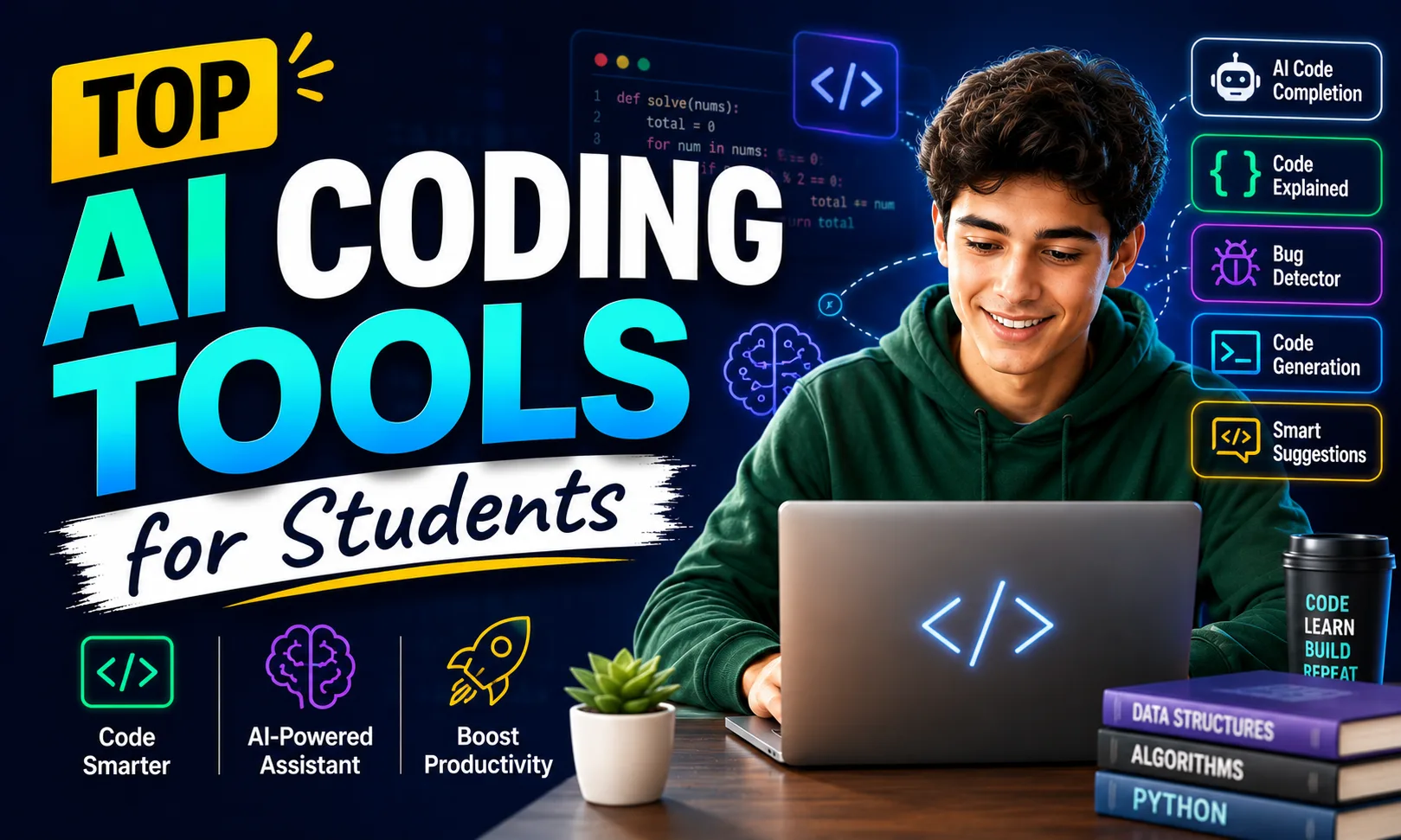
Is GitHub Copilot the only option, or are there smarter picks for students who can’t spend ₹1,500 a month just to autocomplete their code? I spent a few weeks testing the top AI coding tools for students — free tiers, paid plans, actual output quality — so you don’t have to burn money figuring it out yourself. Here’s the full breakdown.
Whether you’re doing DSA prep for placements, building your first full-stack project, or taking freelance gigs on Fiverr — the right AI coding tool can genuinely cut your debug time in half. The wrong one just adds noise. Let’s get into it.
Quick Comparison: Top AI Coding Tools for Students
| # | Tool | Best For | Free Tier | Paid Price |
|---|---|---|---|---|
| 1 | GitHub Copilot | IDE autocomplete | Yes (students) | $10/mo (~₹850) |
| 2 | Cursor | AI-first editor | Yes (limited) | $20/mo (~₹1,700) |
| 3 | Replit AI | Browser-based coding | Yes | $7/mo (~₹595) |
| 4 | Tabnine | Privacy-first autocomplete | Yes | $12/mo (~₹1,020) |
| 5 | ChatGPT (code) | Explaining concepts | Yes | $20/mo (~₹1,700) |
| 6 | Claude | Long code review | Yes | $20/mo (~₹1,700) |
| 7 | Codeium | Free Copilot alternative | Yes (unlimited) | $12/mo (~₹1,020) |
| 8 | Amazon CodeWhisperer | AWS projects | Yes | $19/mo (~₹1,615) |
| 9 | Phind | Dev-focused search + code | Yes | $17/mo (~₹1,445) |
| 10 | Pieces for Developers | Code snippet management | Yes | Free mostly |
Buy AI Tools at Cheapest Price
1. GitHub Copilot — Best for IDE Autocomplete
GitHub Copilot is probably the name you’ve heard most. And honestly, for good reason. It sits inside VS Code, JetBrains, Neovim — wherever you already work — and suggests entire function bodies as you type. I tested it on a React component and a Django REST API in the same session. Both times, the suggestions were 70-80% usable without editing.
The best part for students: GitHub offers Copilot completely free if you verify your student status through GitHub Education. That’s the full Pro plan — no restrictions — at ₹0. This single fact makes it the default starting point for any student list of top AI coding tools for students.
The downside? It doesn’t explain what it’s doing. You get code, not understanding. For someone still learning, that’s a real problem. Use it as a speed tool, not a teacher.
2. Cursor — Best AI-First Code Editor
Cursor is a VS Code fork that bakes AI directly into the editor — not as a plugin, but as the actual brain of the app. You can select broken code, hit Ctrl+K, describe what you want fixed, and it rewrites it in place. I tested the same buggy Express.js route in Copilot and Cursor — Cursor’s fix was the only one I’d have sent to a client without another pass.
The free tier is genuinely usable. You get 2,000 completions and 50 slow GPT-4 requests per month. The Pro plan at $20/month (~₹1,700) — roughly the same as a Netflix Premium subscription — removes those limits and adds faster models. For freelancers taking Upwork projects, the Pro plan pays for itself if it saves you even two hours a month.
It’s the most complete tool among the top AI coding tools for students who are serious about building real projects, not just passing lab assignments.
3. Replit AI — Best for Browser-Based Coding
No local setup. No “my laptop can’t run Node” problems. Replit runs your code in the browser and the AI assistant helps you write, debug, and even deploy it. For college students on older machines or shared computers, this matters a lot. The free tier covers most beginner use cases without hitting a wall immediately.
Replit AI at $7/month (~₹595) is the most affordable paid option here. It’s worth it if you’re doing collaborative projects or quick prototypes. Not ideal for large codebases though — the browser environment has limits.
Solid pick for first-year students just getting into coding.
4. Tabnine — Best for Privacy-Conscious Students
Some colleges — especially those with NDAs or research projects — don’t want your code going to OpenAI servers. Tabnine has a local model option that runs entirely on your machine. No data leaves your laptop. That’s the main pitch, and it’s a real differentiator.
The autocomplete quality is decent but a step below Copilot. Free tier works fine for basic completions. If privacy is a concern for you or your institution, Tabnine deserves a spot on your list of top AI coding tools for students.
5. ChatGPT (for Code) — Best for Learning Concepts
ChatGPT isn’t a coding tool in the IDE sense — but it’s arguably the most useful thing on this list for someone still learning. Ask it to explain why a pointer is causing a segfault, or to walk you through a sorting algorithm step by step, and it does it patiently and clearly. No other tool here does that as well.
The free plan (GPT-3.5) handles most explanation tasks fine. GPT-4o on the $20/month plan is noticeably better at complex debugging. Use the free version first — upgrade only when you feel the ceiling.
6. Claude — Best for Long Code Review
Claude’s big advantage is its context window. You can paste an entire file — even multiple files — and ask it to review for bugs, style issues, or architecture problems. ChatGPT cuts off earlier. I pasted a 600-line Python script into Claude once and got back a genuinely useful code review with specific line references. Impressive.
Free tier exists but hits rate limits fast. The $20/month plan is the same price as ChatGPT Plus. Between the two, I’d pick Claude for code review and ChatGPT for concept explanation. Both belong in your toolkit if you’re serious about these top AI coding tools for students.
7. Codeium — Best Free Copilot Alternative
Codeium gives you unlimited free autocomplete. No student verification needed, no monthly cap. It works inside VS Code, JetBrains, and a bunch of other editors. The suggestion quality is close enough to Copilot that most beginners won’t notice the difference.
If you don’t qualify for GitHub’s student program or just don’t want to go through that process — start with Codeium. It’s genuinely one of the most paisa vasool picks among the top AI coding tools for students.
8. Amazon CodeWhisperer — Best for AWS Projects
If your project involves S3, Lambda, DynamoDB, or any other AWS service — CodeWhisperer is trained on AWS documentation and will suggest correct IAM policies, SDK calls, and configurations that other tools guess at. The individual tier is free. That’s the one most students will use.
Outside of AWS, it’s average. Within AWS projects, it’s genuinely the sharpest tool in the room.
9. Phind — Best Dev-Focused Search with Code
Phind is a search engine built specifically for developers. Ask it a technical question and it returns a real explanation with working code — not just Stack Overflow links. It pulls from current documentation, which means the answers are more up to date than what ChatGPT sometimes gives you from its training cutoff.
Free plan is solid. The $17/month (~₹1,445) Pro plan adds GPT-4 level models. Worth bookmarking even if you don’t pay.
10. Pieces for Developers — Best for Code Snippet Management
This one is different. Pieces doesn’t write code — it saves and organizes the code you already have. It captures snippets from your browser, your IDE, even screenshots, and lets you search them later with natural language. For students who research a lot and forget where they found that perfect regex — this is the fix. Mostly free. Worth installing.
Real Use Cases by User Type for Top AI Coding Tools for Students
- DSA / Placement prep: ChatGPT for concept explanation + Codeium for autocomplete in LeetCode practice
- First-year beginners: Replit AI — no setup friction, works on any machine
- Freelancers on Fiverr/Upwork: Cursor Pro — the quality output is client-ready faster
- Final year project / capstone: Claude for architecture review + GitHub Copilot for daily coding
- AWS cloud projects: CodeWhisperer, no question
- Research / NDA work: Tabnine local model
If you want to go deeper on how these tools compare for professional freelancing work, check out our guide to best AI tools for freelancers — a lot of the same names show up there, but the use cases shift significantly.
My Personal Pick from These Top AI Coding Tools for Students
If I had to pick one tool for a student starting today — it’s GitHub Copilot on the free student plan. Zero cost, works inside VS Code, and the autocomplete quality is the best in this list. Verify your student email, get it free, use it for a semester.
If you’re already past the basics and doing freelance work — switch to Cursor Pro. The $20/month (~₹1,700) is real money, but the output quality difference is noticeable. I tested the same prompt on three tools — Cursor was the only output I’d send to a client without editing it first.
And keep Codeium or Phind open in a second tab regardless of what you’re paying for. Both are free. Both are useful. There’s no reason not to.
For more context on how AI tools are reshaping coding education in India, also read our breakdown of AI tools for learning to code — especially relevant if you’re self-taught.
FAQs About Top AI Coding Tools for Students
Are these top AI coding tools for students available in India?
Yes, all 10 tools are accessible in India. Most accept international cards, and several work with UPI via platforms like Razorpay or international card processors. GitHub Copilot’s student plan is fully free — no payment needed at all.
Which tool is best for complete beginners?
Replit AI or ChatGPT. Both explain what’s happening, not just generate code. That matters when you’re still building the mental model of how programming works.
Can I use multiple AI coding tools at once?
Absolutely. Most developers use 2-3 tools in combination. A typical setup: Copilot or Codeium inside the IDE, ChatGPT or Phind open in a browser tab for questions. No conflict.
Will using AI tools hurt my actual coding ability?
Only if you copy-paste without reading. Use them to learn patterns and review suggestions critically — they make you faster without making you dependent, as long as you stay curious about the why.
Try the free plan for a week on any of the top AI coding tools for students listed here, and drop your experience in the comments. Curious which one actually sticks for Indian students in real college conditions.