
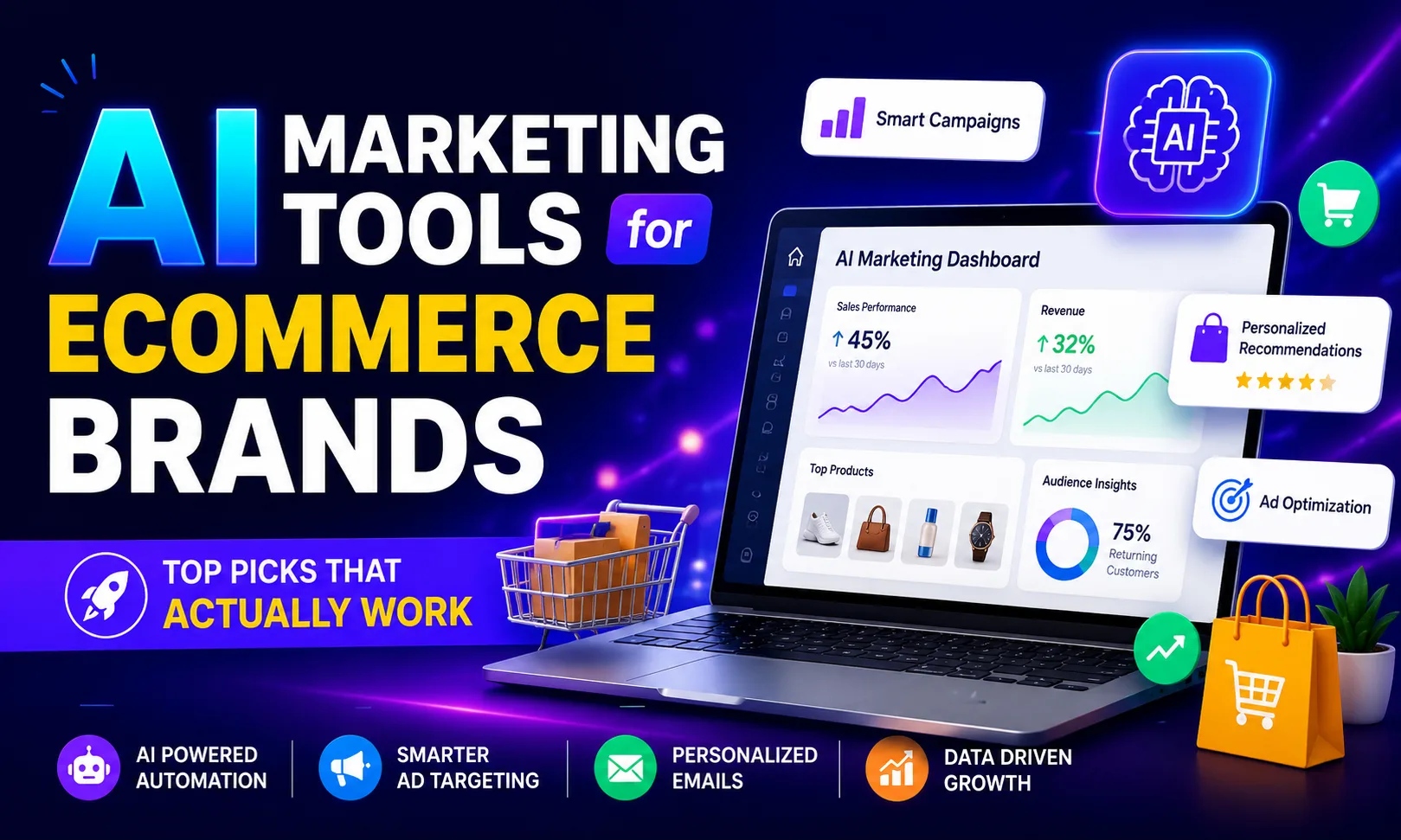
AI marketing tools for ecommerce brands have gone from “nice to have” to genuinely essential — especially when you’re competing with bigger budgets and tighter margins. I’ve tested a bunch of these tools across D2C brands and agency projects, and the ones on this list actually move the needle on leads, conversions, and cost per acquisition.
Table of Contents
- Quick Comparison: AI Marketing Tools for Ecommerce Brands
- 1. Jasper AI — Best AI Marketing Tools for Ecommerce Brands for Product Copy
- 2. Mailchimp — Best AI Marketing Tools for Ecommerce Brands for Email Automation
- 3. Canva — Best AI Marketing Tools for Ecommerce Brands for Visual Content
- 4. Semrush — Best AI Marketing Tools for Ecommerce Brands for SEO and Competitor Research
- 5. InVideo — Best AI Marketing Tools for Ecommerce Brands for Video Ads
- 6. Copy AI — Best AI Marketing Tools for Ecommerce Brands for Bulk Ad Copy
- 7. Opus Clip — Best AI Marketing Tools for Ecommerce Brands for Short-Form Video
- 8. Customer.io — Best AI Marketing Tools for Ecommerce Brands for Behavior-Based Messaging
- How to Pick the Right AI Marketing Tools for Ecommerce Brands
- My Personal Pick from These AI Marketing Tools for Ecommerce Brands
- FAQs About AI Marketing Tools for Ecommerce Brands
Quick Comparison: AI Marketing Tools for Ecommerce Brands
| Tool | Best For | Free Plan | Paid From |
|---|---|---|---|
| Jasper AI | Product copy, ad content | Limited (7-day trial) |
[aitool id=”jasper-ai”]
|
| Mailchimp | Email automation + segmentation | Yes |
[aitool id=”mailchimp”]
|
| Canva | Social creatives, product banners | Yes |
[aitool id=”canva”]
|
| Semrush | SEO, keyword research, competitor tracking | Limited |
[aitool id=”semrush”]
|
| InVideo | Product video ads, reels | Yes |
[aitool id=”invideo”]
|
| Copy AI | Ad copy, landing pages, bulk content | Yes |
[aitool id=”copy-ai”]
|
| Opus Clip | Short-form video from long content | Limited |
[aitool id=”opus-clip”]
|
| Customer.io | Behavior-based messaging automation | No |
[aitool id=”customer-io”]
|
Buy AI Tools at Cheapest Price
1. Jasper AI — Best AI Marketing Tools for Ecommerce Brands for Product Copy
Jasper AI is purpose-built for marketing copy, and ecommerce brands feel that immediately. You feed it your product name, USP, and tone — it spits out product descriptions, Meta ad headlines, email subject lines, and category page intros. Fast. I’ve seen D2C skincare brands cut their content turnaround from 3 days to 4 hours using Jasper’s Brand Voice feature, which remembers your tone across all outputs.
The Jasper AI Chrome extension works directly inside Google Docs and your Shopify backend. That’s genuinely useful. No copy-paste switching between tabs. It also integrates with Canva and Surfer SEO, so your product copy is optimized for search before it goes live. Honestly, for high-SKU ecommerce stores, this saves lakhs per year in freelance writing costs.
The cons? It can get repetitive if you’re generating bulk content without enough prompt variation. And the pricing isn’t entry-level friendly for a bootstrapped brand just starting out. But if you’re at ₹10L+ monthly GMV, the ROI math is simple.
2. Mailchimp — Best AI Marketing Tools for Ecommerce Brands for Email Automation
Mailchimp has evolved hard. It’s not just a newsletter tool anymore — the AI-powered send-time optimization, subject line generator, and predictive segmentation make it one of the most practical AI marketing tools for ecommerce brands selling through their own website or Shopify. The abandoned cart email flow alone recovers 5–15% of lost revenue for most stores, and setup takes under 30 minutes.
The free plan supports up to 500 contacts with basic automation, which is enough for brands just starting email marketing. As you scale, the paid tiers add multivariate testing and behavioral targeting — so you can send different sequences to first-time buyers versus repeat customers. Indian ecommerce brands running Diwali or Big Billion Day campaigns find this segmentation especially useful for not burning the whole list with irrelevant offers.
One real limitation: Mailchimp’s ecommerce-specific analytics are strong only if you’re on Shopify or WooCommerce. Custom-built stores need some dev work for proper event tracking.
3. Canva — Best AI Marketing Tools for Ecommerce Brands for Visual Content
Canva’s Magic Studio — the AI layer on top of Canva — is something every ecommerce marketing team should be using. Magic Design generates on-brand social posts and product banners from a single prompt. Magic Eraser removes cluttered backgrounds from product shots. Magic Write generates caption-ready text directly inside your design. For brands running 30+ creatives a month across Instagram, Meta Ads, and WhatsApp — this cuts design costs significantly.
The free plan is genuinely usable. Paid unlocks Brand Kit (custom fonts, colors, logos) and removes the watermark from AI-generated elements. For a D2C fashion or food brand running festival campaigns, Canva Pro pays back in hours saved in the first week alone.
4. Semrush — Best AI Marketing Tools for Ecommerce Brands for SEO and Competitor Research
If your ecommerce brand depends on organic traffic — and most should — Semrush is the most complete AI marketing tool for tracking what’s working. The Keyword Magic Tool finds long-tail product queries your competitors are ranking for. The Site Audit catches technical issues hurting your category pages. And the new AI-powered writing assistant inside Semrush generates SEO-optimized product descriptions based on real keyword data. That’s a workflow that used to require three separate tools. Now it’s one. Semrush also tracks your top competitors’ ad spend and creatives, which is gold for festival season planning.
It’s not cheap, and the learning curve is real. But for any ecommerce brand spending more than ₹50,000/month on Google Ads, the competitor intelligence alone justifies the cost.
5. InVideo — Best AI Marketing Tools for Ecommerce Brands for Video Ads
Video content is non-negotiable for ecommerce now — Instagram Reels, YouTube Shorts, Meta video ads. InVideo’s AI takes your product URL or a text brief and generates a ready-to-publish video with voiceover, subtitles, and stock visuals in minutes. For brands without a video team, this is the fastest path to video content at scale. The free plan gives you decent output, but watermarks on exports. Paid removes those and unlocks more premium stock and AI voice options.
6. Copy AI — Best AI Marketing Tools for Ecommerce Brands for Bulk Ad Copy
Copy AI shines for ecommerce brands that need high-volume ad copy — think Google Shopping descriptions, A/B test variants for Meta ads, or bulk product taglines. The Workflows feature lets you automate repetitive copy tasks: feed it a product CSV, get back 500 descriptions. For agencies managing 10+ ecommerce clients, this is a massive time-saver. Free plan is available with limited runs per month.
7. Opus Clip — Best AI Marketing Tools for Ecommerce Brands for Short-Form Video
Got a 20-minute product demo or founder interview? Opus Clip chops it into 10 viral-ready short clips, adds captions, and scores each clip for “virality” based on engagement patterns. Ecommerce brands doing YouTube or podcast content can repurpose everything for Reels and Shorts without a video editor. The AI is surprisingly good at finding the punchy moments.
8. Customer.io — Best AI Marketing Tools for Ecommerce Brands for Behavior-Based Messaging
Customer.io is for ecommerce brands that have outgrown basic email tools. It tracks user behavior — what pages someone visited, what they added to cart, how long since their last purchase — and triggers hyper-personalized messages across email, SMS, and push. The AI-suggested campaign logic helps non-technical marketers build flows that would otherwise need a dev. It’s not cheap and has no free plan, but for brands at scale, the lifetime value improvement is measurable.
How to Pick the Right AI Marketing Tools for Ecommerce Brands
- Step 1: Map your biggest cost center
Is it content creation, paid ads, email, or SEO? Pick AI marketing tools for ecommerce brands that attack that specific problem first — don’t buy five tools at once. - Step 2: Check native integrations
Shopify, WooCommerce, Razorpay — your tools need to talk to your existing stack. A great tool with no integration creates double work. Always check the integrations page before subscribing. - Step 3: Start with free plans or trials
Most of these tools have free tiers. Run one real campaign before paying. If Mailchimp’s free plan recovers 3 abandoned carts in week one, the paid plan is worth it. Numbers don’t lie. - Step 4: Measure cost per output, not just cost per month
If Jasper AI costs ₹4,000/month but replaces ₹20,000 of freelance copy, the ROI is obvious. Frame every tool purchase in terms of what it replaces or improves — not just the subscription price. - Step 5: Build workflows, not one-off uses
The real power of AI marketing tools comes when you build repeatable workflows — weekly social content batch, monthly email sequence refresh, quarterly SEO audit. One-off use rarely delivers ROI.
My Personal Pick from These AI Marketing Tools for Ecommerce Brands
Honestly, if I had to pick one to start with today — Mailchimp. It’s free to start, directly connects to revenue through abandoned cart and post-purchase flows, and the AI features are genuinely useful without a steep learning curve. Most ecommerce brands I’ve worked with leave email money on the table before anything else. Fix that first.
For brands past ₹20L monthly GMV, I’d add Semrush for SEO and Jasper AI for content at scale. That three-tool combo covers most of the marketing stack. Check out our breakdown of AI tools for digital marketing if you want a broader view, and also best AI content writing tools for deeper content comparisons.
FAQs About AI Marketing Tools for Ecommerce Brands
Q: Which AI marketing tools for ecommerce brands are free to start?
A: Mailchimp (free up to 500 contacts), Canva (free with watermarked AI features), Copy AI (free with limited monthly runs), and InVideo (free with watermarked exports) all have usable free plans. These are among the best AI marketing tools for ecommerce brands on a budget — start with these before committing to paid tiers.
Q: Can AI marketing tools for ecommerce brands replace a full marketing team?
A: Not fully, but they can replace several freelancers. A solo founder using Jasper AI for copy, Canva for creatives, InVideo for video, and Mailchimp for email automation can handle the output of a 3-4 person team for most of the core channels. Strategy and brand judgment still need humans.
Q: What is the best AI marketing tool for ecommerce brands running Meta Ads?
A: For Meta Ads specifically, Copy AI and Jasper AI both excel at generating multiple ad copy variants for A/B testing. Canva handles the visual creatives. Semrush helps you find the right audience keywords. Using all three together covers most of the Meta ad workflow efficiently.
Q: Are AI marketing tools for ecommerce brands worth it for small D2C stores?
A: Yes, especially the free tiers. A small D2C brand can use Mailchimp free for email, Canva free for creatives, and Copy AI free for basic ad copy — spending ₹0 and getting real marketing done. Upgrade only when you hit the limits and can measure direct revenue impact from the tool.
Q: How do AI marketing tools for ecommerce brands help during festival seasons like Diwali?
A: Festival campaigns need high content volume fast — dozens of creatives, email sequences, ad variants, and social posts within days. AI marketing tools for ecommerce brands like Jasper AI and Canva cut that production time by 60–70%. Mailchimp’s segmentation ensures the right offer goes to the right customer segment, avoiding list fatigue during peak sale periods.
Try the free plan on whichever tool matches your biggest bottleneck right now — and bookmark this page to revisit as your stack grows.