
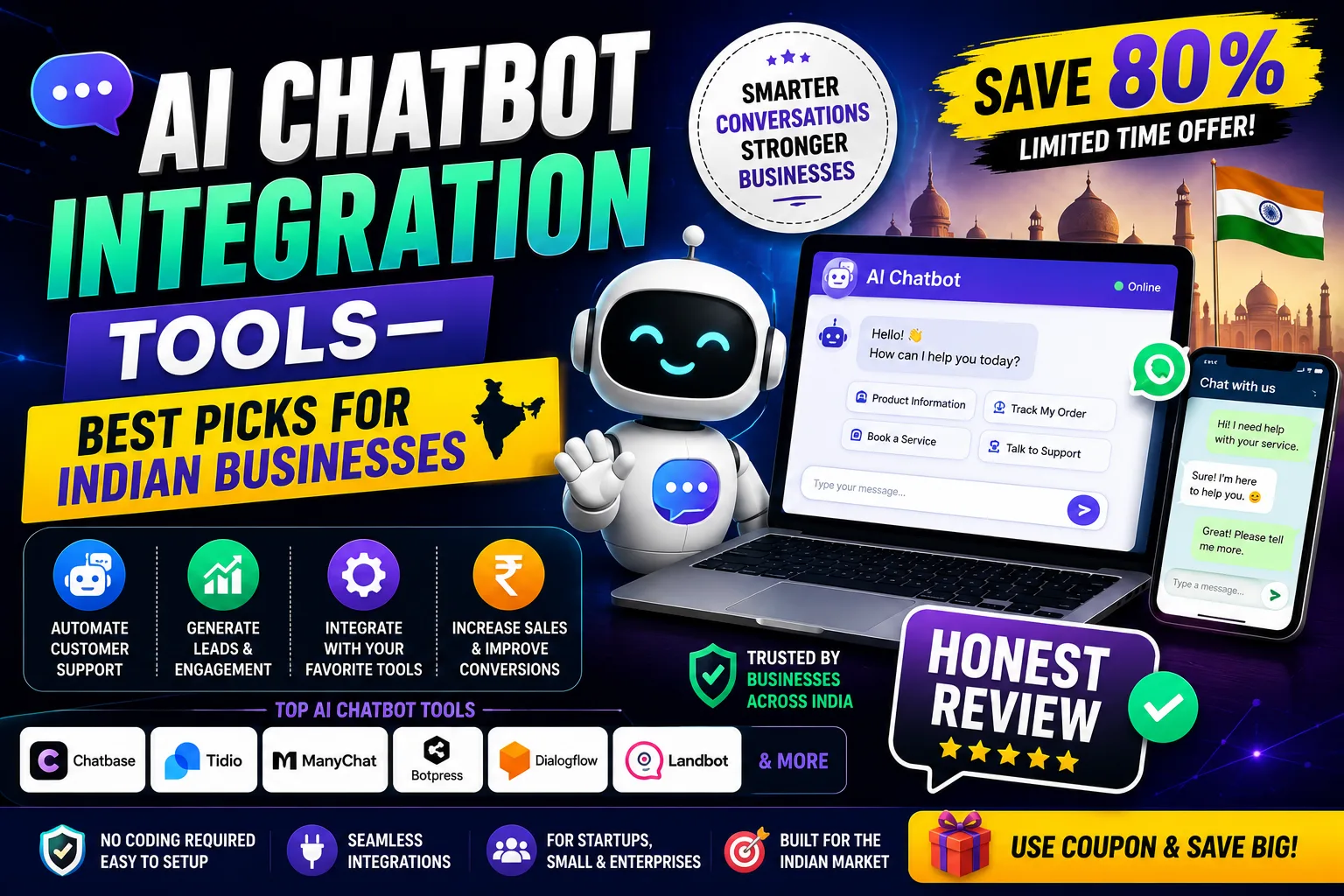
AI chatbot integration tools have gone from “nice to have” to genuinely essential for small businesses handling orders, queries, and festival rush on WhatsApp. I’ve tested several of these tools and the difference between a good one and a bad one is not just features — it’s whether your customers in Pune or Patna can actually understand and use the bot. Here’s what I found.
Table of Contents
- What Is AI Chatbot Integration Tools?
- Who Is AI Chatbot Integration Tools For
- How to Use AI Chatbot Integration Tools — Step by Step
- What I Liked About AI Chatbot Integration Tools
- What AI Chatbot Integration Tools Doesn’t Do Well
- AI Chatbot Integration Tools Pricing — Worth It in India?
- How AI Chatbot Integration Tools Compare
- FAQs About AI Chatbot Integration Tools
What Is AI Chatbot Integration Tools?
AI chatbot integration tools are software platforms that let you embed, connect, or deploy AI-powered chat agents inside existing apps, websites, or messaging platforms like WhatsApp — without writing a full chat system from scratch.
The “integration” part is the key word. These tools sit between your business logic (your product catalog, your CRM, your Razorpay payment links) and the customer conversation. You configure the bot’s knowledge and personality, connect it to your channels, and it handles the rest. Some tools like Vapi go further and support voice — so the bot actually speaks to your customer, not just texts them.
For Indian businesses, the practical need is this: you can’t be online 24/7 during Diwali season when 400 orders are coming in. A properly integrated AI chatbot handles the “What’s the delivery status?” and “Do you have this in blue?” questions automatically. That’s the real use case here.
Who Is AI Chatbot Integration Tools For
Honestly, I’d break this into three groups.
Small business owners — kirana stores going digital, D2C brands on Instagram and WhatsApp, boutique fashion labels. If you’re doing ₹2–10 lakh/month in revenue and spending 3 hours a day answering the same WhatsApp messages, AI chatbot integration tools will directly save you money.
Freelance developers and agencies — If you’re on Upwork or Fiverr building WhatsApp bots for clients, tools like Vapi give you a clean API to build on top of instead of building from zero. Your margin goes up, delivery time drops.
Mid-size teams — EdTech startups, travel agencies, healthcare clinics. Anyone with repetitive inbound queries and a customer base that uses WhatsApp as their primary communication channel. Think of a coaching institute handling 500 admissions queries in June — AI chatbot integration tools handle that load without hiring 5 extra people.
How to Use AI Chatbot Integration Tools — Step by Step
- Step 1: Pick your channel first
Decide if you need a website widget, WhatsApp bot, voice agent, or all three. This determines which tool fits. Vapi is best for voice. Gemini integrates well with Google products. Don’t pick a tool and then figure out the channel — do it the other way. - Step 2: Create a free account and explore the playground
All major AI chatbot integration tools have free tiers or trials. Sign up, don’t enter a credit card yet. Spend 30 minutes in the test playground before committing. - Step 3: Feed it your business knowledge
Upload your product catalog, FAQs, or price list as a document or paste it directly. The better your input, the smarter the bot. A saree shop should upload size charts and fabric names. A travel agency should upload their packages and T&C. - Step 4: Connect your channel
Use the platform’s native WhatsApp connector or webhook. For payment flows, connect Razorpay or UPI links inside the bot’s response templates. Most tools support this through their API or Zapier-style integrations. - Step 5: Test in Hindi and English
Ask the bot 10 questions in Hinglish — “bhaiya, blue wala hai kya?” — and see how it responds. This is where most AI chatbot integration tools fail Indian businesses. Document the failures and add them to your training data. - Step 6: Go live and monitor for 2 weeks
Don’t “set and forget.” Check the conversation logs every morning for the first two weeks. You’ll find gaps — product names it doesn’t know, questions it deflects badly. Fix those. After two weeks, the bot improves significantly.
If you’re new to this space, also check out our guide on AI tools for Indian small businesses for broader context.
What I Liked About AI Chatbot Integration Tools
The honest answer: the speed of setup has gotten genuinely impressive. Two years ago, building a WhatsApp bot meant hiring a developer for ₹50,000+ and waiting three weeks. Now with tools like Vapi or Gemini’s API, a non-technical founder can have a working demo in an afternoon.
Vapi specifically impressed me for voice use cases. The latency is low enough that it doesn’t feel robotic — which matters a lot when your customer is a 55-year-old in Tier 2 city calling about a return. The per-minute pricing model also makes sense for smaller businesses; you pay exactly for what you use, not a flat ₹8,000/month subscription whether you use it or not.
Gemini handles multilingual inputs surprisingly well. I tested it with mixed Hindi-English sentences and it understood context without me needing to switch language modes manually. Claude is the best for complex, multi-turn conversations — if your customer service involves nuanced queries (insurance, legal queries, medical appointments), Claude holds the thread of conversation better than others.
Nova AI has a simpler builder UI that non-technical business owners can actually navigate without a Fiverr developer on speed dial.
What AI Chatbot Integration Tools Doesn’t Do Well
See, here’s the thing — the Indian language gap is still real. Most AI chatbot integration tools are primarily trained on English data. When a customer sends “mujhe kal delivery chahiye, possible hai?” the bot might understand it, but might respond in pure English. That breaks the trust immediately for regional customers.
WhatsApp Business API access is another friction point. Meta requires business verification, and the approval can take 2–4 weeks. During that time, you’re stuck. This isn’t the tool’s fault directly, but if you’re planning a Diwali campaign, start the WhatsApp API application in September.
Pricing for high-volume usage also adds up fast. A chatbot handling 10,000 conversations a month will cost meaningfully more than the base plan advertises. Always calculate your estimated monthly message volume before committing to a paid plan.
And honestly, none of these tools can handle genuinely angry customers well. If someone is furious about a wrong delivery and writing in all caps, the bot will technically respond but the human escalation path needs to be set up manually by you. That’s a configuration step most guides skip.
AI Chatbot Integration Tools Pricing — Worth It in India?
| Tool | Free Plan | Paid Plan | Best For |
|---|---|---|---|
| Vapi | Yes | [aitool id=”vapi”] | Voice bots, API developers |
| Gemini | Yes | [aitool id=”gemini”] | Multilingual text chatbots |
| Claude | Yes | [aitool id=”claude”] | Complex conversation flows |
| Nova AI | Limited | [aitool id=”nova-ai”] | Non-technical business owners |
For most Indian small businesses, the free tiers are enough to validate whether the tool works for your use case. Go paid only when you’re hitting message limits or need the API access. At ₹85 to a dollar, even mid-tier paid plans translate to ₹1,700–₹3,400/month — cheaper than one part-time customer service hire.
Buy AI Tools at Cheapest Price
How AI Chatbot Integration Tools Compare
| Feature | Vapi | Gemini | Claude | Nova AI |
|---|---|---|---|---|
| Voice Support | ✅ Yes | Partial | ❌ No | ❌ No |
| Hindi Support | Partial | ✅ Good | ✅ Good | Basic |
| WhatsApp Ready | Via API | Via API | Via API | Native |
| No-Code Builder | ❌ No | Partial | ❌ No | ✅ Yes |
Also worth reading: how WhatsApp Business AI tools work for Indian sellers — goes deeper on the Meta API setup specifically.
For voice-first use cases, Vapi’s documentation is genuinely one of the better developer resources I’ve seen. And if you’re evaluating AI readiness for your business more broadly, IndiaAI’s official portal has resources specifically for SMBs.
FAQs About AI Chatbot Integration Tools
Q: Which AI chatbot integration tools work best for WhatsApp in India?
A: Nova AI has the most beginner-friendly native WhatsApp setup. For developers, Vapi and Gemini both offer reliable APIs that connect to WhatsApp Business. You’ll need Meta’s WhatsApp Business API approval regardless of which tool you use — that process takes 2–4 weeks.
Q: Do AI chatbot integration tools support Hindi and regional languages?
A: Gemini and Claude handle Hindi and Hinglish reasonably well out of the box. Vapi supports multiple Indian languages for voice. However, deep regional language support (Tamil, Telugu, Marathi) varies — always test your specific language before going live.
Q: What is the cost of AI chatbot integration tools for a small Indian business?
A: Most AI chatbot integration tools have free tiers that work for low-volume testing. Paid plans typically range from $10–$20/month (roughly ₹850–₹1,700/month at current rates). Vapi charges per minute of voice usage, which can be more economical for seasonal businesses.
Q: Can I use AI chatbot integration tools without coding knowledge?
A: Nova AI is the most no-code-friendly option in this list. Gemini has a middle-ground setup. Vapi and Claude are more developer-oriented. If you have zero coding background, start with Nova AI or hire a freelancer on Fiverr for the initial setup — it’s usually a one-time cost.
Q: Are AI chatbot integration tools useful for festival season traffic spikes?
A: Absolutely — this is one of the strongest use cases. AI chatbot integration tools handle unlimited simultaneous conversations, so a Diwali spike from 10 daily queries to 500 doesn’t overwhelm the bot. Just make sure your product and delivery information is updated in the bot’s knowledge base before the season starts.
Try the free plan on whichever tool matches your channel — WhatsApp, website, or voice — before spending anything. The free tiers across these AI chatbot integration tools are genuinely useful for validating your use case. Bookmark this page and come back once you’ve tested your first bot flow.