

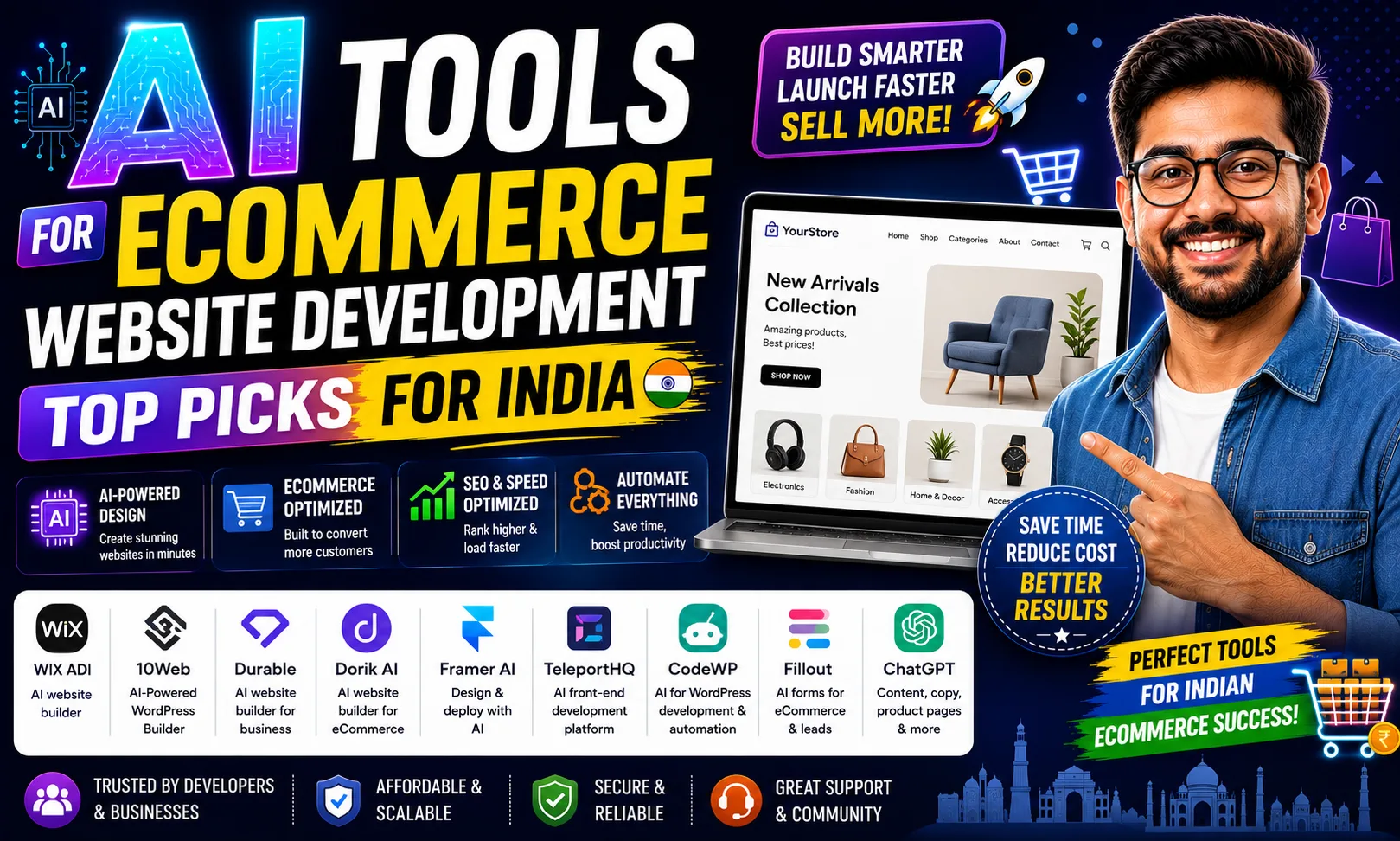
AI tools for ecommerce website development have genuinely changed what one developer or a small agency can ship in a week. I’ve tested several of them while building stores for clients on Upwork, and the speed difference is real — what used to take 3 weeks now takes 3 days. Here’s a no-fluff breakdown of the ones worth your time.
Table of Contents
- Quick Comparison: AI Tools for Ecommerce Website Development
- 1. Lovable — Best AI Tools for Ecommerce Website Development (Full-Stack)
- 2. Bolt — Best AI Tools for Ecommerce Website Development for Rapid Prototyping
- 3. Bubble.io — Best AI Tools for Ecommerce Website Development Without Code
- 4. Replit — Best AI Tools for Ecommerce Website Development for Developers
- 5. Supabase — Best AI Tools for Ecommerce Website Development Backend
- 6. Webflow — Best AI Tools for Ecommerce Website Development for Designers
- 7. Framer — Best AI Tools for Ecommerce Website Development Landing Pages
- 8. Railway — Best AI Tools for Ecommerce Website Development Deployment
- How to Pick the Right AI Tools for Ecommerce Website Development
- My Personal Pick from These AI Tools for Ecommerce Website Development
- FAQs About AI Tools for Ecommerce Website Development
Quick Comparison: AI Tools for Ecommerce Website Development
| Tool | Best For | Free Plan | Paid From |
|---|---|---|---|
| Lovable | Full-stack store from prompt | Limited | |
| Bolt | Instant prototype + deploy | Yes | |
| Bubble.io | Complex no-code ecommerce logic | Yes | |
| Replit | Developers who want AI coding help | Yes | |
| Supabase | Backend + database for ecommerce | Yes | |
| Webflow | Designer-led stores with AI assist | Limited | |
| Framer | Landing pages + marketing sites | Yes | |
| Railway | Deploying ecommerce backends fast | Limited |
Buy AI Tools at Cheapest Price
1. Lovable — Best AI Tools for Ecommerce Website Development (Full-Stack)
AI tools for ecommerce website development don’t get more end-to-end than Lovable. You describe your store — “a saree boutique with Razorpay checkout, product filters by fabric, and a WhatsApp chat button” — and it generates working React + Supabase code. I’ve watched it produce a product listing page with cart logic in under 10 minutes. No hand-holding required from a backend developer.
What makes it stand out is the edit-in-chat approach. If the generated checkout flow doesn’t match your client’s UPI flow, you just tell it in plain English. The iteration loop is fast. It’s not perfect — complex inventory logic or custom shipping rules sometimes need manual fixes — but for a Fiverr or Upwork client who needs a store up quickly, it’s genuinely impressive. Check Lovable’s official site to see the kinds of apps people are shipping.
Pricing starts at . The free tier has limited message credits, which runs out fast during active development. My suggestion: use free to validate the concept, then upgrade when you’re in actual build mode. Indian freelancers building ₹30,000–₹50,000 storefronts for small businesses will recover the subscription cost in one project.
2. Bolt — Best AI Tools for Ecommerce Website Development for Rapid Prototyping
Bolt is the tool I reach for when a client says “I just want to see something working by tomorrow.” It builds full-stack apps in the browser — no local setup, no terminal commands. You get a live preview alongside the code. For ecommerce, this means you can spin up a product grid, add a cart, and show the client a working URL before end of day.
The AI in Bolt (backed by StackBlitz’s WebContainers tech) runs Node.js right in the browser. So when you generate an ecommerce store, you can actually test the checkout logic live — not just look at static HTML. Bolt’s website has good examples of what people are building. Paid plans start at . The free tier is genuinely usable for small projects.
Honestly, Bolt is best for developers who want AI speed but still want to read and own the code. It’s not a click-and-done platform — it’s more like having a senior developer pair-programming with you at 10x speed. For AI tools for ecommerce website development, this is my second favourite behind Lovable.
3. Bubble.io — Best AI Tools for Ecommerce Website Development Without Code
Bubble.io is the go-to when your ecommerce store has complicated logic — loyalty points, vendor dashboards, multi-currency, subscription products. It’s visual programming. You drag elements, define workflows, and connect a database without writing SQL. The AI features now help generate those workflows from plain language descriptions, which cuts setup time significantly.
The platform has a real learning curve. Plan for a few days before you feel comfortable. But once you do, you can build things that would take a React developer weeks. Indian businesses selling through Razorpay or Cashfree can connect payment APIs directly. Pricing is at . The free plan is functional for learning but puts Bubble branding on your app.
4. Replit — Best AI Tools for Ecommerce Website Development for Developers
Replit is where developers who want AI coding assistance without leaving the browser end up. Its AI agent can generate ecommerce backends — Node.js APIs, database schemas, authentication flows — from natural language. You stay in control of the code, which matters when a client asks “can we add GST calculation logic?” six weeks after launch.
The collaborative features are useful for small teams. A developer in Mumbai and a designer in Bangalore can both be in the same Replit project simultaneously. For AI tools for ecommerce website development in a team context, this is underrated. Paid plans from . Free tier supports basic projects.
5. Supabase — Best AI Tools for Ecommerce Website Development Backend
Supabase isn’t a website builder. It’s the backend that powers ecommerce stores built with other AI tools. Think: product database, user authentication, order management, real-time stock updates. When you build with Lovable or Bolt, they often generate Supabase integration automatically — which tells you how central it has become to this stack.
For Indian developers, the free tier (500MB database, 50,000 monthly active users) is genuinely enough for a small store’s first few months. It scales cleanly. Paid from . If you’re serious about AI tools for ecommerce website development, learn Supabase — it shows up everywhere in this ecosystem. See how other AI web development tools integrate with backend platforms like this.
6. Webflow — Best AI Tools for Ecommerce Website Development for Designers
Webflow’s AI tools help designers build ecommerce stores that look custom — not like every other Shopify theme. You get pixel-perfect control over layout, animations, CMS collections for products, and now AI-assisted copy and layout suggestions. For client work where the brand is everything, Webflow is hard to beat.
The ecommerce plan lets you sell products directly, handle inventory, and connect payment processors. The AI features are still maturing but the core builder is excellent. Paid from . Webflow is one of the stronger AI tools for ecommerce website development when the client cares deeply about visual identity.
7. Framer — Best AI Tools for Ecommerce Website Development Landing Pages
Framer is where you build the storefront marketing page — the one that converts visitors before they even see your product catalogue. Its AI can generate entire page layouts from a text description, and the animation capabilities are genuinely impressive for a no-code tool. Pair it with an ecommerce backend and you get a beautiful, fast-loading store front. Paid from .
8. Railway — Best AI Tools for Ecommerce Website Development Deployment
Railway handles deployment — getting your ecommerce backend live without managing servers. When you’ve built your store with Replit or coded it from scratch, Railway deploys it with a few clicks and manages scaling automatically. Paid from . For AI tools for ecommerce website development, this is the “last mile” piece that many developers overlook until launch day.
How to Pick the Right AI Tools for Ecommerce Website Development
- Step 1: Define your technical comfort level
Non-coders should start with Bubble.io or Lovable. Developers will get more from Replit or Bolt. Designers lean toward Webflow or Framer. - Step 2: Map your store’s complexity
Simple catalogue + checkout? Lovable or Bolt. Complex logic (subscriptions, multi-vendor)? Bubble.io. Backend-heavy store? Combine Replit + Supabase + Railway. - Step 3: Check payment integration support
Verify that your chosen AI tools for ecommerce website development support Razorpay, Cashfree, or Paytm if you’re building for Indian customers. Most do via API or plugins. - Step 4: Test the free tier first
All eight tools here have a free or trial option. Build a small proof-of-concept before committing ₹2,000–₹4,000/month on paid plans. - Step 5: Plan for handoff
If you’re a freelancer, clients will ask for access. Tools like Webflow and Bubble.io have clean client handoff workflows. Lovable exports code. Make sure your chosen tool fits your delivery model. Check out AI tools for freelancers to see what works well in client delivery workflows.
My Personal Pick from These AI Tools for Ecommerce Website Development
See, here’s the thing — if I’m building one store solo for a client in the next week, I’m using Lovable for the frontend and store logic, Supabase for the database, and Railway to deploy. That stack generates working code I can hand over, version control on GitHub, and actually debug six months later when something breaks.
Bubble.io is my second pick for clients who want to manage their own store without touching code afterward — the visual editor makes it genuinely empowering for non-technical store owners. For a deeper look at how no-code AI platforms fit into broader workflows, also check no-code AI website builders comparison on this site.
Try the free plan on Lovable or Bolt first. If you outgrow it in a day — that’s a good sign, not a bad one.
FAQs About AI Tools for Ecommerce Website Development
Q: Which AI tools for ecommerce website development work best for beginners in India?
A: Bubble.io and Lovable are the easiest entry points. Bubble.io has no coding required and a visual interface most people understand within a weekend. Lovable lets you describe your store in plain language and generates working code. Both have free tiers to start without spending money.
Q: Can AI tools for ecommerce website development integrate with Razorpay or UPI?
A: Yes. Lovable, Bubble.io, Webflow, and Replit all support Razorpay integration either natively or via API. Lovable and Replit generate the API integration code directly. Bubble.io has community-built Razorpay plugins. Always test payment flows in sandbox mode before going live.
Q: How much do AI tools for ecommerce website development cost for Indian freelancers?
A: Most tools range from $15 to $29/month (roughly ₹1,300–₹2,500/month at current rates). Lovable is around $20/month, Bubble.io starts at $29/month, Webflow from $23/month. Most have free tiers that are usable for small projects or client demos before you need to pay.
Q: Do AI tools for ecommerce website development replace developers entirely?
A: Not entirely. They replace a lot of the repetitive scaffolding work — setting up product pages, cart logic, authentication. But complex custom features, payment edge cases, and post-launch debugging still benefit from a developer’s eye. Think of these AI tools as multipliers, not full replacements.
Q: Which AI tools for ecommerce website development are best for festival sale traffic spikes?
A: Railway and Supabase handle scaling well during Diwali or Big Billion Day type traffic because they auto-scale infrastructure. If you’ve built on Bubble.io, upgrade to a higher plan before peak sales. Webflow’s hosting is also quite reliable under traffic surges. Always load-test before a major sale event.