

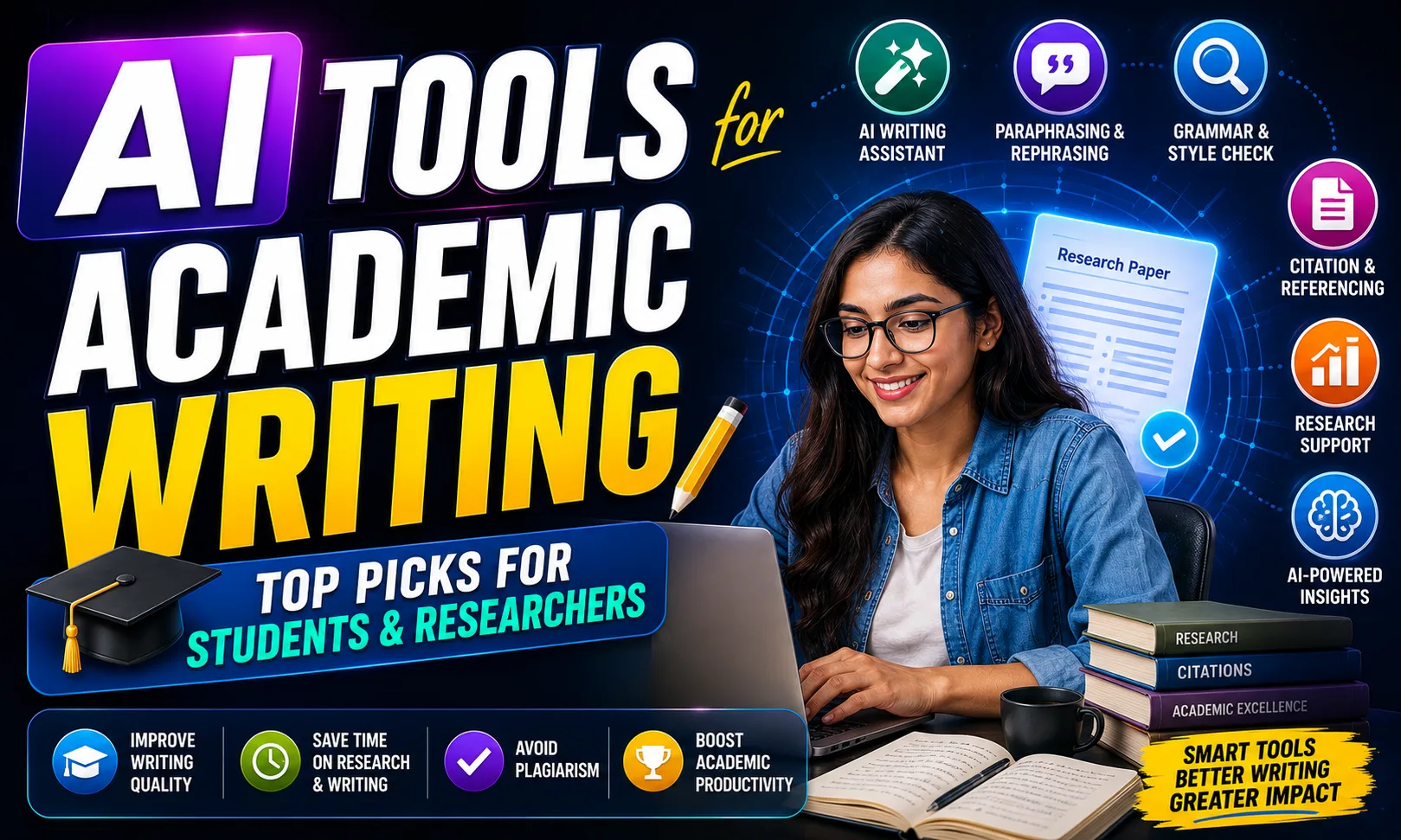
AI tools for academic writing have genuinely changed how students, researchers, and PhD scholars work — from drafting literature reviews to polishing citations. I’ve tested most of these personally, and the quality gap between free and paid tiers is real. Here’s what actually works.
Table of Contents
- Quick Comparison: AI Tools for Academic Writing
- 1. Claude — Best AI Tool for Academic Writing Long-Form Drafts
- 2. Grammarly — Best AI Tool for Academic Writing Grammar Tone
- 3. QuillBot — Best AI Tool for Academic Writing Paraphrasing
- 4. Writesonic — Best AI Tool for Academic Writing Essay Drafts
- 5. Gemini — Best Free AI Tool for Academic Writing Research Q A
- 6. Scalenut — Best AI Tool for Academic Writing Outlines
- 7. Surfer SEO — Best AI Tool for Academic Writing Visibility
- How to Pick the Right AI Tool for Academic Writing
- My Personal Pick from These AI Tools for Academic Writing
Quick Comparison: AI Tools for Academic Writing
| Tool | Best For | Free Plan | Paid Plan |
|---|---|---|---|
| Claude | Long-form drafting, research synthesis | Limited | [aitool id=”claude”] |
| Grammarly | Grammar, clarity, academic tone | Yes | [aitool id=”grammarly”] |
| QuillBot | Paraphrasing, summarizing papers | Limited | [aitool id=”quillbot”] |
| Writesonic | Essay drafts, structured writing | Limited | [aitool id=”writesonic”] |
| Scalenut | Research-backed content outlines | Limited | [aitool id=”scalenut”] |
| Surfer SEO | Academic blog posts, journal visibility | No | [aitool id=”surfer-seo”] |
| Gemini | Research Q&A, Google Docs integration | Yes | [aitool id=”gemini”] |
Buy AI Tools at Cheapest Price
1. Claude — Best AI Tool for Academic Writing Long-Form Drafts
AI tools for academic writing don’t get better than Claude when you need to synthesize a 30-page paper. Claude handles very long context windows — you can paste an entire research paper and ask it to generate a critical analysis or pull out methodology gaps. That’s genuinely rare among free-tier tools.
The free plan does have message limits. You’ll hit the cap mid-afternoon if you’re doing a full literature review in one sitting. Paid access is where the real power is — it stays focused across thousands of words without losing thread. I’ve used it to structure a 4,000-word thesis chapter outline in one go, which would’ve taken me a full day manually. Anthropic’s Claude is especially good at nuanced academic tone — it doesn’t sound like a content mill.
One honest con: Claude doesn’t cite sources. It won’t hallucinate references like older GPT models sometimes do, but you still have to find and verify your citations separately. So treat it as a drafting partner, not a research database. [aitool id=”claude”]
2. Grammarly — Best AI Tool for Academic Writing Grammar & Tone
Grammarly is the most-used AI tool for academic writing grammar checks in India — and for good reason. The free version catches basic grammar errors. But the paid plan adds academic tone suggestions, clarity rewrites, and a plagiarism checker that actually compares against published journals.
The browser extension works inside Google Docs, which is huge if your university uses G-Suite. It flags passive voice overuse, hedging language (“it seems that”), and awkward sentence constructions — all common problems in academic writing. For non-native English speakers writing thesis drafts, the clarity suggestions alone are worth the subscription. Grammarly’s academic features are well-documented and updated regularly.
Where it falls short: Grammarly won’t help you generate content or structure arguments. It’s purely an editor. If you paste AI-generated text into Grammarly, it may flag it as needing a rewrite anyway — so the tools work best in sequence, not parallel. [aitool id=”grammarly”]
3. QuillBot — Best AI Tool for Academic Writing Paraphrasing
QuillBot is the go-to among Indian college students on a budget. The free tier gives you 125 words per paraphrase cycle — enough for a sentence or short paragraph. The paid plan removes that limit entirely and adds a summarizer that can condense a 20-page journal article into 5 bullet points.
Its academic mode specifically uses formal register, which matters when you’re rewriting a paragraph from a source to avoid plagiarism while keeping the meaning intact. The summarizer is genuinely useful for literature reviews — paste in an abstract, get a one-liner for your notes. The citation generator (APA, MLA, Chicago) is a real time-saver too.
But see, here’s the thing — over-relying on QuillBot creates a real plagiarism risk of a different kind. If everyone in your department uses the same paraphraser, the output patterns become recognizable to AI detectors. Use it as a starting point, then rewrite in your own voice. [aitool id=”quillbot”]
4. Writesonic — Best AI Tool for Academic Writing Essay Drafts
Writesonic works well for structured essay drafts where you know your argument but need a first draft fast. Its “Article Writer” mode lets you input a topic and key points, and it generates a formatted draft with headings. For academic blog posts, conference abstracts, or research summaries, it’s quicker than Claude.
The free tier is limited to around 10,000 words per month — fine for a couple of drafts but not a full semester. Paid plans scale significantly. Indian freelancers on Fiverr and Upwork often use Writesonic for academic content projects priced between ₹500–₹2,000 per essay. [aitool id=”writesonic”]
5. Gemini — Best Free AI Tool for Academic Writing Research Q&A
Gemini is Google’s answer to ChatGPT, and for academic writing it has one huge advantage: native Google Docs and Google Scholar integration. You can ask it to summarize a paper you’ve found, suggest related search terms, or help structure a research question — all within your existing workflow.
The free tier is genuinely useful. It doesn’t cap you as aggressively as other tools. For students using Google Workspace (which most Indian universities now provide), Gemini is the most frictionless of all the AI tools for academic writing on this list. [aitool id=”gemini”]
6. Scalenut — Best AI Tool for Academic Writing Outlines
Scalenut is primarily an SEO content tool, but its “Cruise Mode” outline generator works surprisingly well for academic structure. You input a topic, it pulls related concepts and suggests a logical flow. For researchers writing grant proposals or policy papers where structure matters as much as content, this saves real time. [aitool id=”scalenut”]
7. Surfer SEO — Best AI Tool for Academic Writing Visibility
Honestly, Surfer SEO isn’t for traditional academic papers. But if you’re a researcher writing academic blog content, policy briefs meant for public audiences, or thought-leadership articles for journals with an online presence — Surfer helps you write in a way that gets found. It analyzes top-ranking content for your topic and gives you a keyword density target. Not cheap, but researchers who also write for general audiences will find it useful. [aitool id=”surfer-seo”]
How to Pick the Right AI Tool for Academic Writing
- Step 1: Define your use case
Drafting a dissertation chapter needs Claude. Fixing grammar needs Grammarly. Paraphrasing a source needs QuillBot. Don’t use one tool for everything. - Step 2: Check your institution’s AI policy
Many Indian universities now have explicit rules on AI-generated content submission. Check how AI writing tools work within academic integrity guidelines before submitting anything. - Step 3: Start with free tiers
Grammarly and Gemini have the most generous free plans. Test both before spending a rupee. - Step 4: Run plagiarism checks separately
AI tools for academic writing don’t replace a dedicated plagiarism checker like Turnitin. Always run a final check before submission. - Step 5: Rewrite AI output in your voice
AI gives you a draft, not a final submission. Edit it. Add your own analysis. That’s where the actual academic value lives.
My Personal Pick from These AI Tools for Academic Writing
If I had to pick one, it’s Claude for heavy drafting and Grammarly for polishing. That combination costs less than a single textbook per month and covers 90% of what most students need. See how these stack up against other AI writing tools if you want a broader comparison.
For students on zero budget — Gemini free tier plus QuillBot free tier is a genuinely workable combo. You won’t get the best output, but you’ll get something to edit. And editing is faster than writing from scratch. Explore more free AI tools built for students if budget is the main constraint.
Try the free plan on Claude or Gemini this week — even one session will show you how much faster research drafting can get.
Q: What are the best AI tools for academic writing available for free?
A: The best free AI tools for academic writing include Grammarly (free grammar and clarity checks), Gemini (free research Q&A with Google Docs integration), and QuillBot (free paraphrasing up to 125 words per cycle). These three together cover most basic academic writing needs without spending anything.
Q: Are AI tools for academic writing safe to use in Indian universities?
A: It depends on the university’s policy. Most Indian universities are still forming official AI policies. Using AI tools for academic writing to assist drafting or grammar is generally accepted, but submitting AI-generated text as original work can be considered academic dishonesty. Always disclose AI use if your institution requires it.
Q: Which AI tools for academic writing are best for paraphrasing without plagiarism risk?
A: QuillBot’s academic mode is the most popular for paraphrasing. However, always edit the output in your own voice — paraphrased text from AI tools can still be flagged by AI detectors if left unchanged. Use paraphrasing as a starting draft, not a final submission.
Q: How much do AI tools for academic writing cost in India?
A: Prices vary. Grammarly Premium is around $12/month (roughly ₹1,020). QuillBot Premium is about $10/month (roughly ₹850). Claude Pro is $20/month (roughly ₹1,700). Most tools offer monthly or annual billing — annual plans are typically 40-50% cheaper. Students should check for .edu email discounts, which several tools offer.
Q: Can AI tools for academic writing help with citations and references?
A: QuillBot has a built-in citation generator supporting APA, MLA, and Chicago formats. Gemini can suggest references based on your topic. However, Claude and Grammarly do not generate citations. Always verify any AI-suggested reference against the actual source — AI tools occasionally produce inaccurate citation details.