
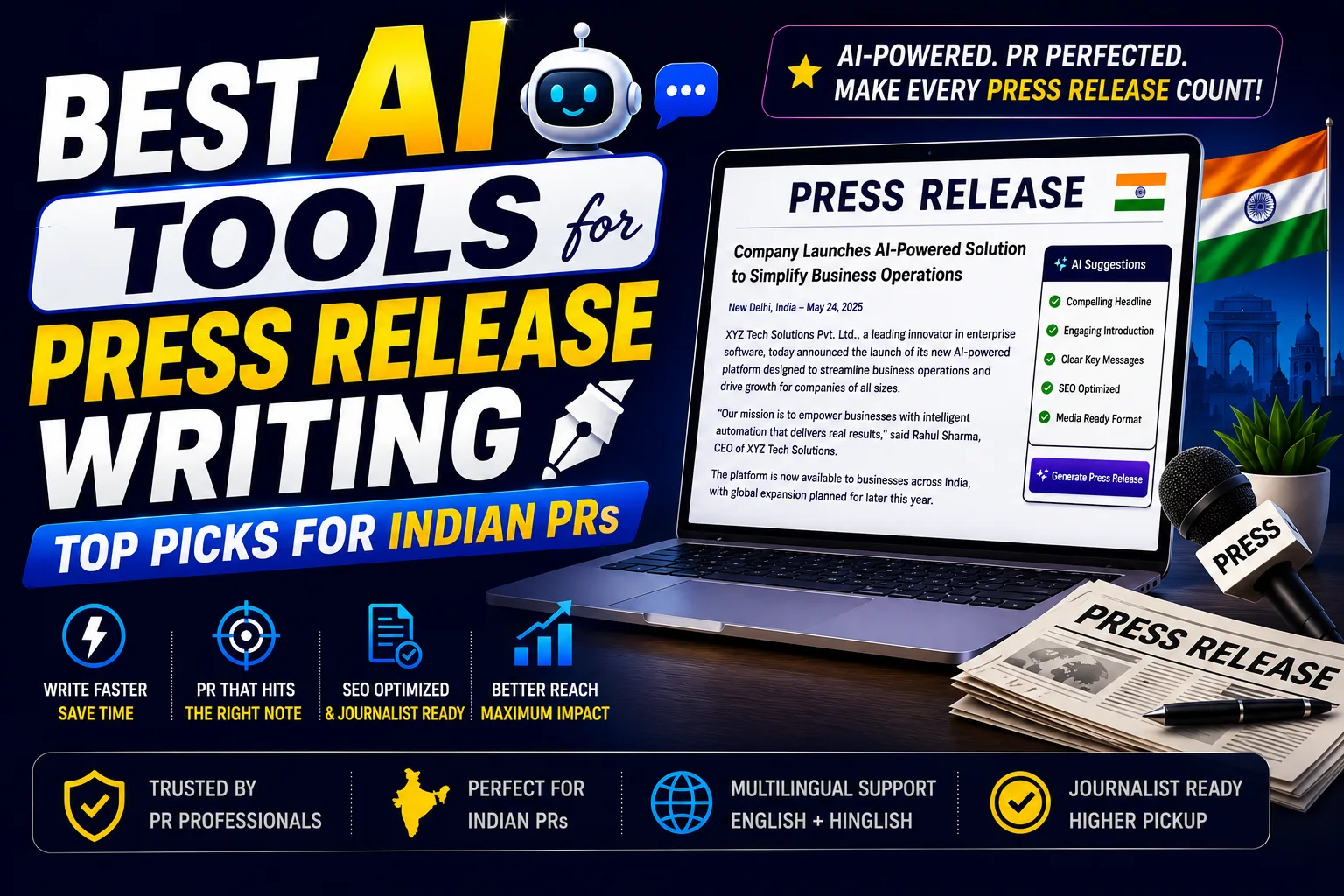
Finding the best AI tools for press release writing is genuinely useful right now — whether you’re a startup founder drafting your own product launch PR or a freelance writer on Upwork handling five clients at once. Press releases have a very specific format, tone, and flow. Not every AI writing tool actually gets that right.
Table of Contents
- Quick Comparison: Best AI Tools for Press Release Writing
- 1. Jasper AI — Best AI Tool for Press Release Writing with Templates
- 2. Writesonic — Best AI Tool for Press Release Writing at Speed
- 3. Copy AI — Best AI Tool for Press Release Writing for Teams
- 4. Claude — Best AI Tool for Press Release Writing for Natural Tone
- 5. Rytr — Best Budget AI Tool for Press Release Writing
- 6. Grammarly — Best AI Tool for Polishing Press Release Writing
- 7. Scalenut — Best AI Tool for SEO-Optimized Press Release Writing
- How to Pick the Right Tool for Press Release Writing
- My Personal Pick from These Best AI Tools for Press Release Writing
- FAQs About Best AI Tools for Press Release Writing
Quick Comparison: Best AI Tools for Press Release Writing
| Tool | Free Plan | Paid | Best For |
|---|---|---|---|
| Jasper AI | No |
[aitool id=”jasper-ai”]
|
PR templates, agency use |
| Writesonic | Limited |
[aitool id=”writesonic”]
|
Speed, bulk PR writing |
| Copy AI | Limited |
[aitool id=”copy-ai”]
|
Workflows, team use |
| Claude | Yes |
[aitool id=”claude”]
|
Natural tone, long-form PR |
| Rytr | Yes |
[aitool id=”rytr”]
|
Budget freelancers |
| Grammarly | Yes |
[aitool id=”grammarly”]
|
Tone + grammar polish |
| Scalenut | No |
[aitool id=”scalenut”]
|
SEO-optimized PRs |
Buy AI Tools at Cheapest Price
1. Jasper AI — Best AI Tool for Press Release Writing with Templates
Jasper AI is one of the best AI tools for press release writing because it actually has a dedicated press release template — not just a blank text box. You fill in your company name, announcement details, and key quotes. Jasper structures the output with a proper headline, dateline, body paragraphs, and boilerplate section. That matters, because press releases aren’t just essays. Format is everything if you’re sending to wire services or media contacts.
The Brand Voice feature is where Jasper genuinely pulls ahead. If you’ve written PRs for a client before, you can feed Jasper past examples and it will match the tone. Useful for PR agencies handling Diwali product launches, Series A funding announcements, or product recalls — all with different tones. The plagiarism checker is built in too, which reduces the risk of accidentally duplicated phrases (a real concern with AI-generated boilerplate). Check Jasper’s official site for latest template library updates.
Honest cons: no free plan at all. And if your announcement involves technical product specs or complex regulatory language, Jasper sometimes oversimplifies. You’ll still need a human edit pass. But for pure speed — especially if you’re producing three to four PRs a week for different clients on Fiverr or Upwork — this is the strongest dedicated option among all best AI tools for press release writing.
2. Writesonic — Best AI Tool for Press Release Writing at Speed
Writesonic’s press release generator is fast. Genuinely fast — you get a full 400-word draft in under 30 seconds. The interface asks you for a topic, key details, and tone, then outputs something that’s structured correctly with a headline, lead paragraph, body, and contact section. For a freelancer handling multiple clients, that speed compounds across a week into significant time savings.
The free plan is limited to a fixed word count per month, which is enough to test it properly before paying. Writesonic also connects with Surfer SEO for those who want their press releases to also rank on Google — useful for online PRs distributed through news aggregators. The AI Article Writer inside Writesonic can expand a press release into a longer explainer piece if you need one. See also our guide on AI content writing tools for a broader picture.
The output quality is good but occasionally generic. Quotes especially — the AI-generated spokesperson quotes can sound robotic. Always replace those with actual human quotes before publishing. Plagiarism risk is low but not zero, so run it through a checker before submission to any news wire.
3. Copy AI — Best AI Tool for Press Release Writing for Teams
Copy AI works best when a team is involved. The Workflows feature lets you create a multi-step process: input your announcement brief → AI drafts the PR → it checks brand guidelines → outputs a formatted version. If you’re running a small PR agency or an in-house comms team, this kind of structured pipeline reduces back-and-forth. The free tier is limited but functional enough for occasional use.
For press release writing specifically, Copy AI’s “Press Release” use case template generates output that follows standard AP style formatting. The tone stays formal without sounding stiff. It’s one of the more reliable best AI tools for press release writing when you need consistency across multiple announcements — say, a startup announcing monthly funding rounds or quarterly product updates.
4. Claude — Best AI Tool for Press Release Writing for Natural Tone
See, here’s the thing about Claude — it doesn’t have a specific “press release” template, but it writes the most natural-sounding copy of any tool on this list. Ask it to write a press release and give it good context: company name, what happened, why it matters, a spokesperson quote, and the boilerplate. It will structure it correctly and the language won’t sound robotic. Claude also handles nuance well — for example, writing a PR about a product recall or a leadership change requires a careful, measured tone. Claude nails that better than most.
The free plan is genuinely usable. For freelancers starting out who can’t justify a paid subscription yet, Claude’s free tier makes it one of the most accessible best AI tools for press release writing. Pair it with Grammarly for polish and you have a solid no-cost workflow. Read more about how Claude handles AI writing tasks across different formats.
5. Rytr — Best Budget AI Tool for Press Release Writing
Rytr sits at the affordable end of the best AI tools for press release writing. It has a dedicated press release use case, a free plan with 10,000 characters per month, and a paid plan that costs less than most tools here. For solo freelancers writing one or two PRs a week, the free plan covers a surprising amount. The output quality is decent — not exceptional, but structurally correct and easy to edit.
The tone selector is useful: you can switch between “formal,” “informative,” and “enthusiastic” — each producing meaningfully different results for the same input. Rytr doesn’t have plagiarism detection built in, so run the output through a separate checker before client delivery.
6. Grammarly — Best AI Tool for Polishing Press Release Writing
Grammarly isn’t a press release generator — but it’s one of the most important best AI tools for press release writing workflows. Once you have a draft from any other tool, Grammarly catches tonal inconsistencies, passive voice overuse, wordiness, and formatting errors. The “Adjust the Tone” feature in the paid version is specifically helpful: press releases need to sound confident without being arrogant, and Grammarly’s suggestions actually help calibrate that. The free plan catches basic grammar. The paid version is where the real PR polish happens.
7. Scalenut — Best AI Tool for SEO-Optimized Press Release Writing
Scalenut is for PRs that need to rank on Google — think online news distribution, company blogs, or digital newsrooms. It combines AI writing with keyword research and NLP-based content scoring. So while you write the press release, Scalenut tells you which related terms to include and how to improve the content’s topical depth. Useful if your client’s PR also doubles as an SEO asset. No free plan, but the paid tier is reasonable. Check our comparison of AI SEO writing tools if that’s your main need.
How to Pick the Right Tool for Press Release Writing
- Step 1: Identify your volume
Writing one PR a month? Claude’s free plan is enough. Writing five or more per week for clients? Jasper or Writesonic’s paid plans save real time. - Step 2: Check if format matters
Wire services like PRNewswire have strict formatting requirements. Tools with dedicated PR templates (Jasper, Writesonic, Rytr) handle this better than general-purpose writers. - Step 3: Test tone on your niche
A tech startup PR sounds different from a pharmaceutical recall notice. Run the same brief through two tools and compare — most offer free trials. - Step 4: Always check for plagiarism
AI tools sometimes reproduce common boilerplate phrases verbatim. Run every output through a plagiarism checker before client delivery or wire submission. - Step 5: Budget in INR
At ₹85 per USD, even mid-range paid plans cost ₹1,500–₹4,000/month. Calculate your per-PR cost based on volume to see which plan actually makes sense.
My Personal Pick from These Best AI Tools for Press Release Writing
Honestly, for most Indian freelancers and small PR teams — start with Claude’s free plan to draft, Grammarly free to polish, and only upgrade when volume demands it. If you’re already doing PR professionally and billing clients, Jasper’s template system pays for itself in time saved. Writesonic is my pick for speed when deadlines are tight. And Rytr wins purely on the budget-to-quality ratio for beginners.
None of these tools replace the judgment call of a good PR writer — but the best AI tools for press release writing do eliminate the blank-page problem and cut first-draft time by 60–70%. That’s the real value. Explore more on best AI writing tools for Indian content creators to find your full workflow stack.
FAQs About Best AI Tools for Press Release Writing
Q: What are the best AI tools for press release writing for beginners?
A: Claude (free plan) and Rytr are the best AI tools for press release writing if you’re starting out. Both have usable free tiers, correct PR structure, and simple interfaces. Rytr costs around $9/month on its paid plan if you need more volume.
Q: Are the best AI tools for press release writing plagiarism-safe?
A: Mostly yes, but not guaranteed. Boilerplate phrases — “for immediate release,” “about the company” sections — can occasionally match other AI-generated PRs. Always run output through a plagiarism checker like Grammarly or Copyscape before client delivery or wire submission.
Q: Can the best AI tools for press release writing handle Indian company names and context?
A: Yes. Claude, Jasper, and Writesonic all handle Indian company names, UPI/Razorpay references, BSE/NSE mentions, and rupee formatting correctly when you include them in the prompt. Provide specific context — city, sector, spokesperson name — for best results.
Q: Which of the best AI tools for press release writing works without a paid subscription?
A: Claude and Grammarly both have genuinely useful free plans. Rytr and Writesonic have limited free tiers that work for occasional use. Copy AI’s free plan allows a set number of workflow runs per month — enough to test before committing.
Q: Do the best AI tools for press release writing follow AP Style formatting?
A: Copy AI and Jasper follow AP Style most closely — correct dateline format, “FOR IMMEDIATE RELEASE” header, inverted pyramid structure. Claude can follow AP Style if you specify it in the prompt. Always verify dateline formatting manually before wire submission.