
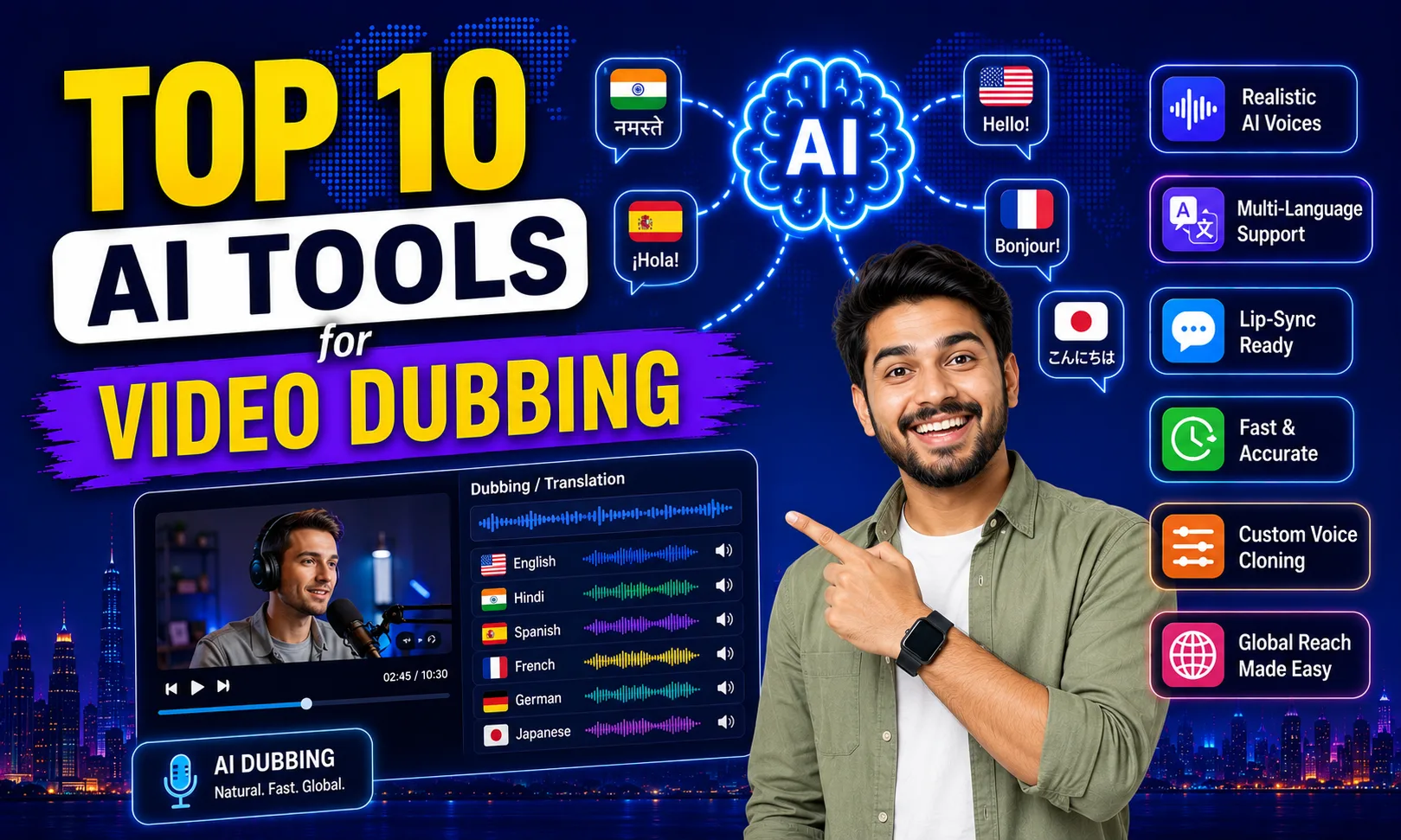
I avoided ElevenLabs for almost a year because I thought it was just another text-to-speech tool with a fancy UI. That was a mistake. When I finally tested it for dubbing a short YouTube explainer into Hindi, the output was clean enough that a client actually asked which voice artist I hired. That moment changed how I think about AI tools for video dubbing entirely.
This post covers 10 tools I’ve actually used or tested — what they’re good at, what they cost in rupees, and which ones make sense for Indian creators making YouTube videos, Instagram Reels, or client content.
Quick Comparison: AI Tools for Video Dubbing
| # | Tool | Best For | Free Tier | Starting Price | Hindi Support |
|---|---|---|---|---|---|
| 1 | ElevenLabs | Voice quality | Yes (limited) | $5/mo (~₹425) | Yes |
| 2 | HeyGen | Avatar + lip sync | Yes (1 min) | $24/mo (~₹2,040) | Yes |
| 3 | Rask AI | Full dubbing workflow | Yes (1 min) | $60/mo (~₹5,100) | Yes |
| 4 | Murf AI | Indian accents | Yes | $19/mo (~₹1,615) | Yes |
| 5 | Dubverse | Indian market focus | Yes | ₹999/mo | Yes |
| 6 | Papercup | Enterprise broadcast | No | Custom | Yes |
| 7 | Speechify Studio | Long-form content | Yes | $29/mo (~₹2,465) | Partial |
| 8 | Vidnoz | Budget creators | Yes | $14.99/mo (~₹1,275) | Yes |
| 9 | Veed.io | Subtitle + dub combo | Yes | $18/mo (~₹1,530) | Yes |
| 10 | Synthesia | Corporate training | No (trial) | $22/mo (~₹1,870) | Yes |
Buy AI Tools at Cheapest Price
1. ElevenLabs — Best for Raw Voice Quality
ElevenLabs is honestly the benchmark right now for voice naturalness. The dubbing feature lets you upload a video, pick a target language, and it handles transcription, translation, and voice synthesis in one go. I tested the same 3-minute explainer video on four tools — ElevenLabs was the only output I’d send to a client without editing. The pacing, the breath patterns, the intonation — all felt real.
Hindi support exists but is still improving. For English-to-Hindi or Hindi-to-English dubbing, results are solid 80% of the time. The free tier gives you 10,000 characters/month, which is tight for video work. Paid starts at $5/month (~₹425), and the $22/month (~₹1,870) Creator plan is where the dubbing feature really opens up.
One limitation: lip sync isn’t built in. It’s a voice tool, not a video editor. So if your video shows a talking face, you’ll need to pair it with another tool. Still, for voiceover-style dubbing — screen recordings, explainers, tutorials — it’s the best in class.
2. HeyGen — Best for AI Avatar + Lip Sync Dubbing
HeyGen does something the others don’t: it actually moves the mouth. The lip sync on translated video is genuinely impressive. Upload a talking-head video, pick a target language, and the avatar’s lip movements adjust to match the new audio. I used this for a client’s product demo that needed an English version of a Hindi recording — the output required maybe 10% manual cleanup.
It supports 40+ languages including Hindi, Tamil, Telugu, and Bengali. The free plan gives you one minute of video. Paid is $24/month (~₹2,040), which feels steep but makes sense if you’re doing client work regularly on Fiverr or Upwork. Export is 1080p without a watermark on paid plans.
The AI avatar voices still have a slight robotic edge in Indian languages — not deal-breaking, but noticeable. For YouTube creators doing face-cam content who want to reach regional audiences, HeyGen is the most complete package among AI tools for video dubbing right now.
3. Rask AI — Best for Full Dubbing Workflow
Rask handles the entire pipeline: transcribe → translate → dub → sync. It’s one of the more polished end-to-end AI tools for video dubbing. The interface is clean, language detection is automatic, and you can manually edit the transcript before dubbing if the AI mistranslates something — which it will, sometimes. Hindi accuracy is around 85% in my experience.
Pricing is the catch. Starting at $60/month (~₹5,100), it’s positioned for agencies and serious creators, not beginners. The free tier allows 1 minute of content. If you’re running a media production house or doing YouTube localization at scale, it’s worth it. Otherwise, look lower on this list.
4. Murf AI — Best for Indian Accent Voices
Murf has an actual Indian English voice that doesn’t sound like a 2010-era GPS. That alone makes it stand out. For creators who want dubbing in Indian-accented English or proper Hindi voiceovers, Murf is the go-to. It supports Hindi, Tamil, Telugu, and more. The voice cloning feature on higher plans lets you replicate your own voice — useful if you want consistency across dubbed content.
Free tier exists but watermarks audio. Paid starts at $19/month (~₹1,615) — roughly the same as Netflix Premium. Annual plan brings it down by about 25%. The video dubbing workflow is slightly more manual than HeyGen or Rask, but voice quality for Indian languages is better than most.
5. Dubverse — Best India-First AI Dubbing Tool
Dubverse is built specifically for Indian creators and media companies. It supports 30+ Indian and global languages, has a clean browser-based editor, and pricing is in rupees — ₹999/month. That’s genuinely accessible. The tool also integrates subtitle generation, so you can dub and caption in one workflow.
Quality is good, not great. For social media content and internal training videos, it works well. For broadcast-quality dubbing, you’d want Papercup or Rask. But for a solo creator making Hindi YouTube videos or regional Reels? Dubverse is paisa vasool.
6. Papercup — Best for Broadcast and Enterprise
Papercup is used by actual TV channels and news publishers for multilingual content. The output quality is noticeably better than consumer tools — voices carry more natural variation, emotion, and pacing. But it’s enterprise-priced with custom quotes. No self-serve free tier. If you’re a media company or a large YouTube channel looking to localize hundreds of hours of content, talk to their team. Otherwise, it’s out of reach for most individual creators.
7. Speechify Studio — Best for Long-Form Content
Speechify started as a read-aloud app and has expanded into studio-grade dubbing. It handles long videos well — podcasts turned into multilingual clips, course content, audiobook-style narration. The voice quality is solid, and the editing interface is more polished than most tools in this price range. At $29/month (~₹2,465), it competes directly with Rask’s lower tier. Hindi support is partial and improving.
8. Vidnoz — Best for Budget Creators
Vidnoz is the most affordable paid option here. At $14.99/month (~₹1,275), you get decent dubbing quality, avatar generation, and 1080p export. It’s not going to replace ElevenLabs on voice quality, but for creators just starting out or testing dubbing as a workflow, it’s a low-risk entry point. Free plan includes a watermark. Hindi support is available but translation accuracy varies.
9. Veed.io — Best for Subtitles + Dubbing Combo
Veed is where I’d send a creator who wants a single tool for everything: cut video, add subtitles, translate, and dub. It’s not the best at any one thing, but the combination is convenient. Auto-subtitle accuracy in English is very high. Hindi subtitles are usable with some corrections. Dubbing quality is middle-of-the-road — better than free tools, not as good as ElevenLabs. At $18/month (~₹1,530), it makes sense if you’d otherwise be paying for separate tools. Canva users who also want video dubbing will find Veed’s UX familiar and easy to pick up.
10. Synthesia — Best for Corporate Training Videos
Synthesia is the standard for corporate L&D and training content. You type a script, pick an avatar, pick a language, and it renders a talking-head video. Dubbing existing videos isn’t its primary use case — script-to-video is. But for companies creating onboarding content in Hindi, Tamil, or Bengali alongside English, Synthesia is excellent. No free tier, but a limited trial exists. Starting at $22/month (~₹1,870).
Real Use Cases by User Type for AI Tools for Video Dubbing
- YouTube creators (English to Hindi): HeyGen for face-cam videos, ElevenLabs for voiceover-based tutorials.
- Freelancers on Fiverr/Upwork: Rask AI or Murf for client delivery quality.
- EdTech / course creators: Speechify Studio or Synthesia for long-form multilingual content.
- Regional Reels creators: Dubverse — affordable, India-first, ₹999/month.
- Agencies / media houses: Papercup for broadcast quality, HeyGen for social-first campaigns.
- Wedding / event videographers: Veed.io for quick subtitle + dubbed highlight reels.
If you’re thinking about how dubbing fits into a broader video creation workflow, check out our roundup of the best AI video tools for a fuller picture.
My Personal Pick from These AI Tools for Video Dubbing
For most Indian creators, I’d start with ElevenLabs for voice quality and Dubverse if budget is tight. If you do face-cam content and want lip sync, HeyGen is worth the ₹2,040/month — it saves you hours of manual editing. And honestly, Murf deserves more attention in India specifically because no other tool gets Indian English voices this right.
The one mistake I see people making is choosing tools based on feature lists instead of output quality. Export a 60-second test clip from three tools and show it to someone who doesn’t know you used AI. Their reaction tells you everything.
See, here’s the thing — the best AI tool for video dubbing is the one that fits your specific content format, language pair, and publishing frequency. There’s no one-size answer. For more on picking the right AI tool for your content type, read our guide on AI tools for content creators in India.
FAQs About AI Tools for Video Dubbing
Which AI tools for video dubbing support Hindi? ElevenLabs, HeyGen, Rask AI, Murf, Dubverse, and Synthesia all support Hindi. Dubverse has the deepest focus on Indian languages overall.
Can I monetize YouTube videos dubbed with AI? Yes, as long as the content itself is original and eligible. YouTube’s monetization policy doesn’t disqualify AI-dubbed audio. But check each tool’s commercial license — most paid plans allow it, free tiers sometimes don’t.
Do these tools add watermarks on free plans? Most do. ElevenLabs watermarks audio on the free tier. HeyGen and Vidnoz watermark exported video. Murf watermarks audio. Upgrade to paid if you’re publishing publicly.
What export quality can I expect? Most tools export up to 1080p on paid plans. HeyGen and Synthesia both cap at 1080p. For 4K, you’d need to dub the audio separately and sync in a video editor.
Are there any free AI tools for video dubbing without watermarks? Honestly, not reliably. Some tools offer limited free exports without watermarks — Rask AI gives 1 free minute, Dubverse has a free tier — but anything production-ready will require a paid plan.
Try the free plan of one or two tools from this list for a week and test with your actual content. Drop your experience in the comments — I’m curious which language pairs you’re working with.